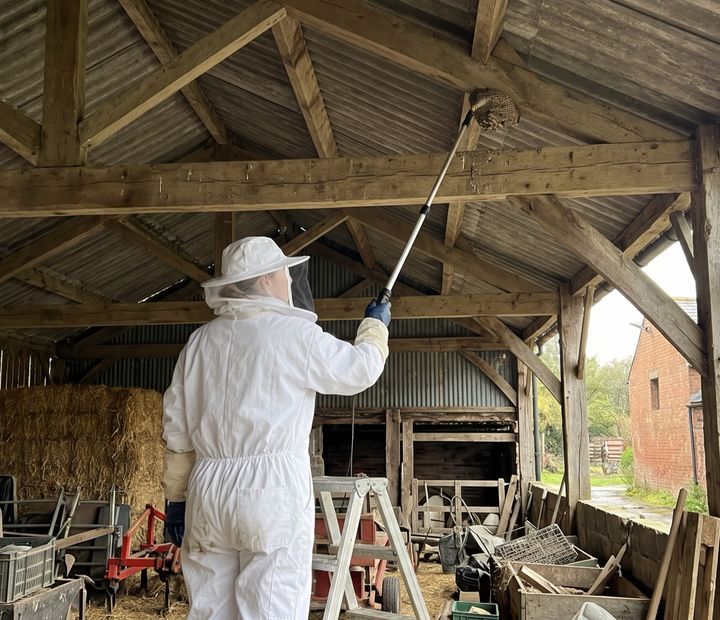
Northwest Environmental deals with wasp and hornet nests across Birchwood, in Oakwood, Gorse Covert, Locking Stumps and on Birchwood Park. A technician traces the flight line to the entrance, puts a professional insecticide dust or foam into it, and the colony usually dies off within a day. Ring us or fill in the contact form to arrange a visit.
Why do wasps do so well in Birchwood?
A queen that wakes from hibernation in spring needs three things: a dry cavity to build in, sound timber to chew into nest paper and a steady supply of insects to feed her first grubs. Birchwood supplies all three. The town was laid out across former heath and mossland, Birchwood Forest Park fills its centre, there is woodland around Pestfurlong Hill near Gorse Covert, and the wet bog of Risley Moss lies alongside. Garden fences, sheds and play equipment provide the wood fibre.
By August a single nest can hold several thousand workers. Once the colony turns to raising new queens and males, the workers have fewer grubs to feed and go looking for sugar instead: ripe fruit, open drinks, recycling bins and the food waste around pubs and takeaways. That late-summer stretch is when wasps become a real nuisance in Birchwood gardens and around business entrances.
Where do we find nests in Birchwood homes?
Most houses here belong to the 1970s new town, so the usual nest sites are those of homes from that period rather than the slipped slates and old stacks of a Victorian street. Inside the roof, wasps get in where a soffit or fascia board has shrunk away from the brickwork, through a gap at the verge or alongside a pipe or cable entry, and build on a rafter or down into the insulation. You may first notice them in an upstairs bedroom or around the loft hatch.
Garages and garden sheds come next, followed by bird boxes, compost bins and the void under decking. Ground nests deserve a special mention in this town. Parts of the old factory land survive as bunkers covered in soil and turf, several of them within Birchwood Forest Park, and banks like these, along with ordinary lawns and rockeries, suit queens that move into an abandoned burrow. Those nests grow out of sight until somebody runs a mower over the entrance.
What about Birchwood Park, the shops and the schools?
Birchwood Park holds 165 businesses, and alongside offices and warehouse units it has food and drink outlets, a hotel, a gym and a nursery. A nest by a main entrance there can put staff, guests and small children in the same flight path, so we agree the timing with the site first, usually before opening or after the working day, and keep a short record of what was used and where.
The town’s schools need the same planning. There are three primary schools, plus a high school with Birchwood College next door, and treatment there is best done outside the school day or in the holidays. The three districts each have a pub, and Birchwood Shopping Centre sits on Dewhurst Road, so food premises across the town see foraging wasps around food and waste from late July.
How does a Birchwood wasp visit run?
It follows the same pattern as every wasp and hornet nest removal we carry out. The technician first confirms the insects are wasps or hornets and not bees, then follows the wasps’ flight path to the nest entrance and checks what is close by: children, pets, neighbours over the fence, a garden pond or, near Risley Moss, wet ground and standing water. Pyrethroid insecticides are highly toxic to fish and aquatic invertebrates, and the moss is protected, so placement matters.
The insecticide dust or foam goes straight into the hole, applied with an extension lance from ground level wherever it will reach. Foragers carry it inside, which is how a nest deep in a loft or a bank is treated without being dug out. Expect a short surge of activity, then a steady decline, with the colony usually dead within a day. The hole must stay open, and the dead nest is normally left in place. European hornets, which favour hollow trees and woodland edges, are dealt with the same way, but later in the evening when they are back at the nest.
How can Birchwood households keep queens away next year?
Once the colony has died off over the winter, fix the gap it used. Refit loose soffit and fascia boards, fit insect mesh over vents without blocking the airflow, and seal around pipe and cable entries. Look through sheds, garages and the loft in April and May, when a new nest is no bigger than a golf ball and far easier to deal with. Through the summer, keep the food waste caddy lid shut, rinse bottles and cans before they go in the recycling, and clear fallen fruit. Businesses on the park can ask their managing agent to check canopies and signage each spring.
Wasp & Hornet Nest Removal in Birchwood: what we see locally
- Most Birchwood homes date from the 1970s new town, so nests tend to sit in roof spaces reached through gaps at soffits and fascias, and in garages and garden sheds, rather than in old chimney stacks.
- Parts of the former factory land survive as bunkers covered in soil and turf, some inside Birchwood Forest Park, and grassed banks like these suit queens that take over an abandoned burrow for an underground nest.
- Birchwood Park combines food and drink outlets, a hotel, a gym and a nursery with its offices and warehouses, so a nest beside a busy entrance there can affect staff, guests and young children at once.
- Each of Birchwood's three residential districts has its own pub, and Gorse Covert also has a takeaway and local shop, and food premises like these draw foraging wasps in August and September.
- Risley Moss next to the town is a Site of Special Scientific Interest kept deliberately wet, so on gardens near its edge we place insecticide with extra care, because the pyrethroids widely used on nests are highly toxic to fish and water insects.
How we deal with it
- 1
Identify the insect and find the nest
We confirm it is wasps or hornets rather than bees, then follow the flight line back to the entrance, whether that is a gap under a tile, a soffit vent, an airbrick or a hole in the lawn.
- 2
Check the surroundings
Before treating we check for children, neighbours, pets, fish ponds, horses or livestock, staff and customers nearby, and ask whether anyone has a known sting allergy.
- 3
Treat the entrance
A professional-use insecticide dust or foam goes directly into the entrance, from the ground with an extension lance where possible. Returning wasps carry it inside, so hidden nests are reached too.
- 4
Leave the entrance open
We explain why the hole must not be blocked, how long to keep people and pets clear, and that a short burst of extra activity is normal while foragers return.
- 5
Remove the nest where it matters
Dead nests are usually left, because wasps never reuse them. Where a nest is in a living space, a well-used shed or a loft where it could draw other insects, we can take it out once inactive.
- 6
Confirm it has worked
Activity normally stops within 24 hours. If wasps are still using the same entrance after a couple of days, or a second nest appears, tell us and we will reassess.
Wasp & Hornet Nest Removal in Birchwood: frequently asked questions
Can you treat a wasp nest in a lawn or grass bank in Birchwood?
Yes. Ground nests turn up wherever there is old turf, rough grass or a bank, and in Birchwood that includes the grassed-over bunkers left from the wartime factory. A queen usually takes over a disused mouse or vole burrow, so the only sign may be wasps dropping into a small hole in the grass. Keep mowers, strimmers and children well away from it, because vibration sets the colony off. We treat the entrance with a lance from a safe distance and leave the hole open, and the lawn can be used normally once activity has stopped.
Our unit on Birchwood Park has a nest in the shared grounds. Who should book the treatment?
It depends who looks after that part of the park. A nest in your own building's fascia, signage or canopy is usually the occupier's to deal with, while one in a shared hedge, verge or bin compound often falls to whoever manages the common areas under the lease. If the nest is beside your entrance, tell the managing agent straight away and keep staff clear. We can take instructions from either party, agree access with site security and send a short record of the job to both.
Is it safe to treat a nest near a Birchwood school or nursery?
Yes, with the timing planned. Birchwood has three primary schools, a high school with Birchwood College beside it, and a nursery on Birchwood Park. On sites like these we treat before children arrive, after they have gone home, at a weekend or during the holidays, and cone off the area if the nest is near a path or gate. The insecticide goes into the nest entrance rather than into the air, and we leave a note of the product, the location and how long the area should stay closed.
We are still seeing wasps in late October. Is there a live nest?
Possibly, but probably a fading one. By late autumn most colonies are failing: the old queen is dying, workers wander about sluggishly looking for sugar, and the new queens have left to find somewhere to hibernate, often in a loft, garage or shed. A steady stream in and out of one gap on a mild day still points to an active nest. Odd single wasps indoors usually do not. The first hard frosts finish the colony, so treating this late is only worth it where the entrance is beside a door or in a living space.
Will my council remove a wasp nest for free?
Probably not. Councils across Cheshire, Merseyside, Lancashire and Greater Manchester handle wasps differently: many charge for the work, some do not treat wasps in homes at all (Cheshire East, for example, treats only rats and mice), and free wasp treatment is uncommon. Where a council does offer it, appointments may be harder to get in late summer, when demand peaks, and there may be limits on the nests it will treat. Your council's pest control page will say what is available. If it does not cover your nest, or you need it dealt with sooner, we can treat it privately.
What kills a wasp nest instantly?
Nothing reliably does. Sprays that promise instant results knock down the wasps you can see, not the colony inside, and spraying a visible nest at close range mainly provokes it. Professional treatment works by placing insecticide dust or foam in the nest entrance; foragers carry it in and spread it through the nest. Expect a burst of activity for an hour or two, then a steady decline. Most nests are dead within 24 hours, although a large nest in a roof space can take a little longer.
Is it a wasp, a hornet or a bee, and will you treat bees?
Wasps are smooth, bright yellow and black, with a narrow waist. European hornets are larger, chestnut-brown and yellow, and often turn up at lit windows after dark. Bees are rounder and hairier. We do not treat honeybees, because insecticide in a honeybee nest can be carried away by bees from other colonies; a local beekeeper may be able to collect a swarm. Bumblebee nests die off naturally by late summer and are usually best left alone. If you are unsure, send us a clear photo before booking.
More in Birchwood
Last updated: