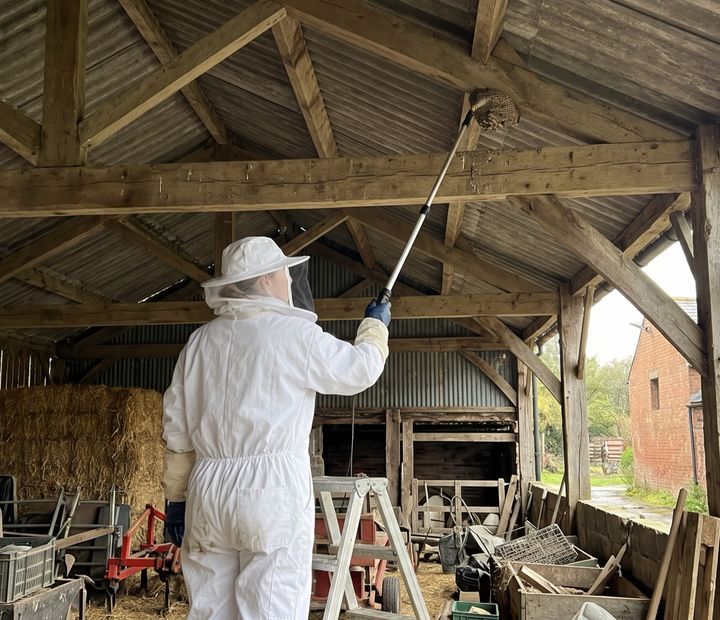
For a wasp or hornet nest in Great Sankey, Penketh, Westbrook or Chapelford, Northwest Environmental sends a technician from Warrington to follow the flight line, then puts a professional insecticide dust or foam into the entrance, usually from the ground. Most colonies die off within a day. Book by phone or through the website form.
Why do wasps do so well around Sankey Valley Park?
A wasp colony needs three things: a dry cavity, wood fibre to build with and plenty of insects to feed its grubs. The valley that runs from Sankey Bridges up to Callands provides two of those in abundance. Its meadow and wetland breed the flies and caterpillars that workers hunt through early summer, and fence panels and sheds in nearby gardens, along with timber in the park’s play areas, supply the wood they scrape into nest paper. The third, the cavity, is supplied by the houses nearby.
By August the pattern shifts. Colonies stop raising workers, and the adults go looking for sugar instead, which brings them to the park’s picnic benches and to patio tables and open bins in gardens near the valley. That is why a household can be plagued by wasps without having a nest of its own. The valley’s mature woodland also offers the hollow trees European hornets prefer, so the occasional large, chestnut-coloured insect at a lit window is not unusual here.
What do we find in Westbrook and Chapelford roofs?
On suburban houses, most nests sit at roof level. On the early 1980s estates of Westbrook, the entrance is often a small gap behind a fascia or at the end of a soffit board, where the timber has shrunk or a fixing has worked loose. The nest itself is then built in the eaves void or pushed back into the loft insulation, sometimes several metres from the hole the wasps use.
Chapelford is different. Building began there in 2001, on land that was once part of RAF Burtonwood, so the brickwork is recent and generally tight. Queens instead use the ventilation built into modern roofs: slotted soffit vents, dry-fixed ridges and verges. Nests in these houses can grow large without anyone noticing until wasps start appearing around a downlighter or the loft hatch.
In established gardens, ground nests are more common than people expect. Queens take over an abandoned rodent burrow in a lawn or bank, or the space under a compost bin, and mowing over the entrance is often how the nest is found.
Nests on business sites
Penketh Business Park, the warehousing at Omega and the retail yards at Gemini and the Westbrook Centre all have the features wasps like: cladding joints, hollow signage frames, canopy voids and bin compounds with a steady supply of sugary waste. A nest beside a loading door or a café entrance is a hazard for staff and the public, so we agree a time with the site manager and leave a short written note of where we treated and what was used.
How does a nest visit run here?
The visit follows the same steps as anywhere we work, adjusted for the setting. Our technician confirms the insects are wasps or hornets, not bees, and finds the entrance from the flight line. Before treating, we ask about children, pets and anyone with a sting allergy, and check whether Sankey Brook, the canal or a garden pond is close, because many wasp products are harmful to fish and other aquatic life.
The dust or foam goes into the entrance itself, from the ground with a lance wherever possible. Returning foragers carry it in, so a nest hidden behind a soffit or under insulation is reached without opening the roof. Expect a brief surge of activity, then a steady fall; the hole must stay open while that happens.
Keeping next year’s queens out
After the first hard frosts the old nest is empty and can be dealt with. Winter is the time to fix a loose fascia, fit insect mesh behind soffit vents without blocking airflow, and fill gaps around pipes and cables. In April and May, check sheds, garages and the loft once a fortnight, because a nest the size of a golf ball is far easier to treat than one the size of a football in August. Keeping the food waste caddy and bins closed in late summer makes a garden near the valley far less attractive to foraging workers.
Wasp & Hornet Nest Removal in Great Sankey & Penketh: what we see locally
- Gardens near Sankey Valley Park sit beside meadow, wetland and mature woodland, so foraging wasps are common there in late summer, and old trees in the valley are the sort of place European hornets choose for a nest.
- Westbrook's main estates date from the early 1980s, and the gaps that open behind ageing fascias and soffits on houses of that period are a frequent way in for a queen in spring.
- On Chapelford's homes, built from 2001 on former RAF Burtonwood land, queens usually get in through vented soffits and dry-fixed verges rather than through the brickwork.
- Cladding joints, canopies and bin compounds at Penketh Business Park, the Omega warehousing and the Gemini and Westbrook retail yards put nests close to doors that staff and customers use all day.
- Where a nest sits near Sankey Brook or the canal, much of which still holds water, we keep insecticide well back from the bank, because many wasp products harm fish and other aquatic life.
How we deal with it
- 1
Identify the insect and find the nest
We confirm it is wasps or hornets rather than bees, then follow the flight line back to the entrance, whether that is a gap under a tile, a soffit vent, an airbrick or a hole in the lawn.
- 2
Check the surroundings
Before treating we check for children, neighbours, pets, fish ponds, horses or livestock, staff and customers nearby, and ask whether anyone has a known sting allergy.
- 3
Treat the entrance
A professional-use insecticide dust or foam goes directly into the entrance, from the ground with an extension lance where possible. Returning wasps carry it inside, so hidden nests are reached too.
- 4
Leave the entrance open
We explain why the hole must not be blocked, how long to keep people and pets clear, and that a short burst of extra activity is normal while foragers return.
- 5
Remove the nest where it matters
Dead nests are usually left, because wasps never reuse them. Where a nest is in a living space, a well-used shed or a loft where it could draw other insects, we can take it out once inactive.
- 6
Confirm it has worked
Activity normally stops within 24 hours. If wasps are still using the same entrance after a couple of days, or a second nest appears, tell us and we will reassess.
Wasp & Hornet Nest Removal in Great Sankey & Penketh: frequently asked questions
Does Warrington Borough Council deal with wasp nests in Great Sankey and Penketh?
Many councils run a pest control service for residents, but what is covered, who can book and the charges all vary and can change, so check the council's own pest control pages before you book. If you rent, report the problem to your landlord first. If you would rather book a private firm, call or message us to arrange a visit.
Our garden by Sankey Valley Park is full of wasps, but we cannot find a nest. Do we need treatment?
Not necessarily. In August and September workers forage widely for sugar, so wasps over a garden near the park may be coming from a nest in the woodland or a neighbour's property rather than yours. Watch for a steady line of wasps flying to one point on your house, shed or lawn. If there is no such line, treatment will not help; lidded bins, covered drinks and ripe fruit picked up promptly will. If there is, we can trace and treat it.
Can you reach a nest in the soffit of a Chapelford new-build without scaffolding?
Usually, yes. Our extension lance reaches the eaves of most two-storey homes from the ground, so the dust goes straight into the gap the wasps are using while our technician stays clear of the flight path. Taller houses, conservatory roofs and awkward gables are assessed on the day, and where ladder access is needed it is done only if it is safe. If a nest is out of reach from outside, we can often treat it from inside the loft instead.
Why are there single large wasps in our Penketh loft in late autumn?
Those are almost certainly newly mated queens looking for somewhere to hibernate. From late September, colonies break down and the queens leave to overwinter in lofts, sheds, curtain folds and wall voids. A lone queen is not a nest, so no treatment is needed; let her out or remove her. The thing to watch is the following April and May, when a queen that wintered in the roof may start a nest close by.
Will my council remove a wasp nest for free?
Probably not. Councils across Cheshire, Merseyside, Lancashire and Greater Manchester handle wasps differently: many charge for the work, some do not treat wasps in homes at all (Cheshire East, for example, treats only rats and mice), and free wasp treatment is uncommon. Where a council does offer it, appointments may be harder to get in late summer, when demand peaks, and there may be limits on the nests it will treat. Your council's pest control page will say what is available. If it does not cover your nest, or you need it dealt with sooner, we can treat it privately.
What kills a wasp nest instantly?
Nothing reliably does. Sprays that promise instant results knock down the wasps you can see, not the colony inside, and spraying a visible nest at close range mainly provokes it. Professional treatment works by placing insecticide dust or foam in the nest entrance; foragers carry it in and spread it through the nest. Expect a burst of activity for an hour or two, then a steady decline. Most nests are dead within 24 hours, although a large nest in a roof space can take a little longer.
Is it a wasp, a hornet or a bee, and will you treat bees?
Wasps are smooth, bright yellow and black, with a narrow waist. European hornets are larger, chestnut-brown and yellow, and often turn up at lit windows after dark. Bees are rounder and hairier. We do not treat honeybees, because insecticide in a honeybee nest can be carried away by bees from other colonies; a local beekeeper may be able to collect a swarm. Bumblebee nests die off naturally by late summer and are usually best left alone. If you are unsure, send us a clear photo before booking.
More in Great Sankey & Penketh
Last updated: