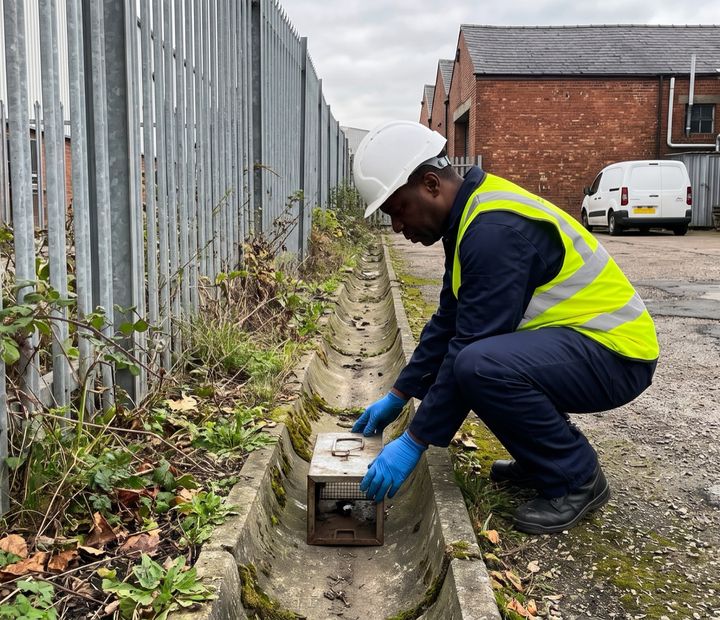
For rats and mice in Runcorn homes, rented flats and business units, including Castlefields, Windmill Hill and the Astmoor estate, Northwest Environmental surveys how they get in, then traps or baits in secured boxes and proofs the gaps, normally across a few visits a week apart. Call or fill in the enquiry form to arrange a visit.
Why are rats so active around Runcorn’s water?
Few parts of Runcorn are far from water. The Mersey runs along the north of the town, the Ship Canal carries the two ports in the west, the Weaver Navigation forms the south-western boundary and the Bridgewater Canal threads through the eastern new town. Brown rats live comfortably in that kind of landscape: they dig into soft banks, move through ditches and drains, and take advantage of anyone feeding the ducks.
Rainwater here heads two ways, some of it to the Mersey and some to the Weaver. With that much drainage running towards the rivers, a cracked joint, an unsealed old connection or a missing cap on an inspection chamber can give a rat a covered route from the sewer into a garden or under a floor. That is why the drains are checked early on most of our jobs here.
What do we typically find in Runcorn homes?
Housing shapes the problem as much as water does. The planned estates spread east after the 1964 designation, and where homes on estates such as Palacefields and Murdishaw are attached, they share roof spaces, ducts and drain runs. Mice in those properties rarely belong to a single house, and the droppings in your kitchen may come from a nest behind the boxing in the next home along.
Rats tend to show up outside first. In gardens close to the Bridgewater Canal we find holes beside sheds and under decks, worn runs along fence lines and burrows next to drain covers that have shifted. In Sandymoor, where most homes went up after 1990, newer construction has fewer old drains, but gaps around service entries and airbricks partly buried by raised soil still let rodents in.
What happens on a Runcorn rodent visit?
The first call is a survey. We identify the species from droppings, runs and gnawing, work out where the animals are living and how they get in, and lift inspection covers if the evidence points to the drains. Before anything is laid, we explain what we found and what we suggest.
Indoors, and anywhere with young children or pets roaming, enclosed traps are often our first choice. If poison is warranted, it is placed in locked boxes secured along the routes the animals use, and each box is marked on a plan. We come back at intervals of about a week, shifting traps or boxes to wherever the animals are now working, and seal or mesh entry points as we find them. If a drain defect is behind it, we show you where and recommend a repair or a rat blocker. Once the signs stop, every item is removed and you receive a short written summary.
What about industrial units, docks and shops?
Runcorn’s working sites are concentrated at Weston Point, the Heath, Astmoor, Manor Park and Whitehouse, with Runcorn Docks and Weston Point Docks on the Ship Canal and a large retail area around Shopping City and Trident Retail Park. Rats work the boundaries of these sites, and mice ride in on pallets, cartons and returned stock. Because the council does not describe any business service, these premises rely on scheduled private monitoring, with a site plan of stations and a report after each visit that an auditor or food safety officer can follow.
Which habits keep rodents away from Runcorn homes?
Start with food. Lock the lid on the new food waste caddy, keep bird seed and pet food in metal bins, and put out only what birds will finish in a day. Closed compost bins, no cooked food on the heap and less clutter behind sheds take away shelter.
Then look at the building. Fine mesh over damaged airbricks, mortar and wire wool packed round pipe entries, a bristle strip along the foot of each outside door and drain covers that sit flat all make a difference. Near the canal, wire mesh buried along the base of a shed or deck stops rats from digging underneath. If the signs keep returning after all that, a broken drain or a route shared with the house next door is the likely explanation, and that is the point to call us.
Rat & Mouse Control in Runcorn: what we see locally
- Halton's own rat service is a basic poison-and-advice visit that hands structural causes back to the owner, so our Runcorn jobs begin by finding the drain fault or gap the rats are actually using.
- Gardens within reach of the Bridgewater Canal, including those near the towpath walks in Phoenix Park, are where we most often find rat holes dug beneath sheds, decks and garden steps.
- Runcorn's land sheds water both to the Mersey and to the Weaver, so on most rat jobs here we lift inspection covers to check whether the sewer is the source before any bait goes down.
- Homes on the planned eastern estates repeat the same layouts and shared drain runs street after street, and mice in one attached house often trace back through a linked loft or service duct to the next.
- Units at Astmoor, Manor Park and Whitehouse take in pallets and packaging every working day, and with no council service described for businesses, rodent monitoring there is arranged privately.
How we deal with it
- 1
Survey and identification
We confirm whether it is rats, house mice or wood mice, follow runs and droppings back to where they are living, and map the ways in, from airbricks and pipe entries to drains and door thresholds.
- 2
A plan you understand
We explain what we found, which method we recommend and why, where traps or stations will go, and anything you need to do first, such as clearing a cupboard or moving pet food and animal feed.
- 3
Trapping or secured baiting
Enclosed traps or tamper-resistant bait stations are fixed on the active runs and every position is recorded. Products are used strictly to their label and to the CRRU UK code of best practice.
- 4
Proofing and drain checks
Gaps are sealed or meshed and door brushes fitted where needed. If drainage is the source, we show you the defect and recommend a rat blocker or repair so the route is closed.
- 5
Follow-up visits
We return, usually about a week apart, to check activity, remove any carcasses, move stations or traps to where the rodents are now working and confirm the proofing is holding.
- 6
Close-out and report
When activity stops, every station, trap and scrap of bait is taken away, and you receive a written summary of what was found, what was done and what to watch for.
Rat & Mouse Control in Runcorn: frequently asked questions
Halton offers rat treatment. Why would I book a private visit in Runcorn?
If you receive council tax reduction, the council's free rat visit is worth knowing about. Be clear on its scope, though: Halton calls it basic rodenticide treatment plus advice, and leaves any structural cause for the owner to sort out. Mice are charged, and the council's pages describe nothing for businesses. A private visit brings the survey, drain checks, trapping where bait is unsuitable, proofing of entry points and return visits until the signs stop, with a written record of the findings.
Could the locking food caddies arriving in Runcorn this autumn attract rats?
Only if the lock is not used. Halton's weekly food waste rounds begin in the week of 2 November, and the kerbside caddy has a lid that locks specifically to keep pests out. Trouble begins when that lid is left unlatched, the caddy is crammed too full or extra bags sit beside it, because meat, fish and bones are what rats are hunting for. Latch it every time, keep it on paving rather than against a hedge or fence, and rinse it now and then so the smell does not build up.
We treated mice in our Runcorn flat, but they came back. Why?
Usually because the mice live in the building, not just your home. In blocks and attached houses they move through service ducts, boxed-in pipework and gaps under kitchen units, so clearing one flat leaves a population next door to recolonise it. We look for the shared routes, seal the gaps on your side and, where the problem spans several homes, explain to the landlord or managing agent why treating the whole block together works better.
Can you monitor rodents at a unit on Manor Park or Whitehouse?
Yes. We agree an inspection frequency with you, fix tamper-resistant monitoring points along external walls, beside dock doors and around bin compounds, and check pallets and goods-in areas for gnawing and droppings. Each visit ends with a report showing what was found and any proofing needed, such as worn roller-shutter seals. On a site that crosses into Preston Brook parish, the same contract and records cover both parts.
Will rats leave on their own if I ignore them?
Rarely. While a building offers food, water and somewhere warm to nest, rats have no reason to move on, and they breed quickly: a female can mate again within a day or so of giving birth, and her young can breed within two to three months. Left in a loft or wall cavity, rats gnaw cables, which is a fire risk, foul insulation and stored belongings, and find their way to the kitchen through service voids. A problem that starts with a few droppings in autumn is often much larger by spring.
Can I legally put rat poison down in my garden?
Only in the way the product label allows. Rodenticides sold to householders are authorised for particular uses, usually indoors or outdoors close to buildings, and many may only be used inside a tamper-resistant bait station. Laying bait loose on open ground, in a hedge or by a compost heap risks poisoning pets, hedgehogs and birds of prey, and using a product against its label conditions can be an offence. Stronger professional products and larger packs are restricted to certified users under the UK rodenticide stewardship regime. In a garden used by children, dogs or hens, trapping is often the safer route.
Why do I keep getting rats under my decking or shed?
Decking and sheds give rats dry, hidden ground to burrow into, and most gardens have food nearby: bird feeders, dropped seed, compost bins, pet food or a hen run. Across much of the North West, a canal, brook or railway embankment close by adds a steady supply of new arrivals. Treating the burrows clears the current group, but others will move in unless the food is removed and the space under the structure is closed with buried mesh or a solid edge. We check the drains as well, because a broken pipe under a patio is often the real source.
More in Runcorn
Last updated: