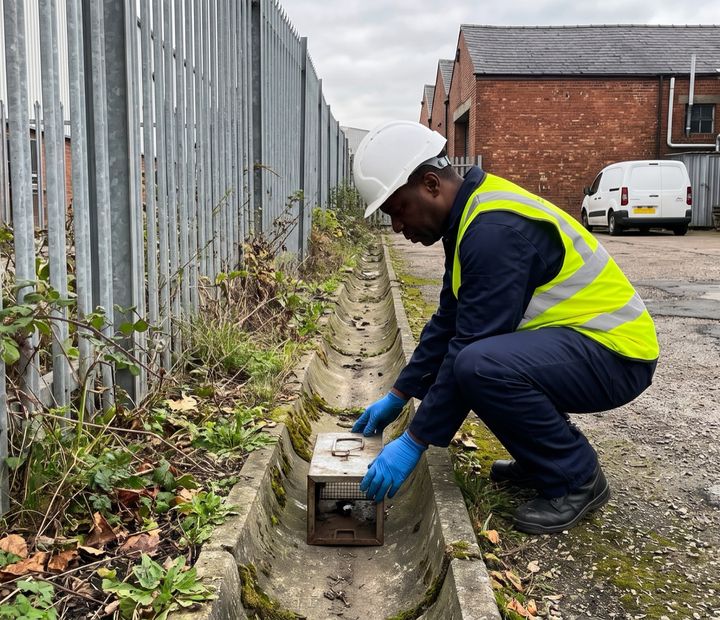
Rats and mice in Widnes homes and business premises, including Hough Green, Upton and units along Ditton Road, are dealt with by Northwest Environmental. A technician surveys first, finds the drain fault or gap being used, sets enclosed traps or locked bait stations and returns weekly until activity stops. Ring us, or send the website form, to book.
Why do Widnes rats follow the brooks and the canal?
Rats rarely arrive at a Widnes house from nowhere. Three brooks, Ditton, Steward’s and Bower’s, drain the town to the Mersey, and each gives brown rats water, bankside cover and a line to travel along between open ground and back gardens. The Sankey Canal adds another corridor, starting at Spike Island and heading inland as a towpath through Sankey Valley Park.
Much of the land by the river has a past as chemical works or tips. Spike Island, where the first works opened in 1847, has been cleared to green space, and the meadows at Pickerings Pasture were made on old landfill. Rough grassland beside water is easy digging, so gardens backing on to these edges see more rat holes under outbuildings and decking than streets further back.
What do we find in the older streets and the newer estates?
Homes in Widnes are generally packed closely together, the legacy of a town that grew fast around its chemical works and absorbed Farnworth, Appleton, Ditton and Upton, once villages in their own right. In those close-built rows the commonest call is mice rather than rats: droppings in a kitchen cupboard, scratching in a ceiling at night, and the same signs next door. Mice travel through shared voids, so we check party walls and talk about treating neighbouring homes together. Rats in older houses more often come from below, through a cracked drain joint or a branch left open when a kitchen or outside toilet was altered.
Newer housing, such as the developments in Ditton and the estate going up on the former Fairfield High School site, usually has sound drains but different weak points: gaps around service pipes, unsealed boxing behind units and airbricks without mesh. Work on the next phase of a site can also move rats out of the ground and into finished gardens.
Freight sheds, food stores and Ditton Road
On the commercial side, rodent risk follows goods. Distribution parks such as 3MG in West Bank and Stobart Park, with its large chilled warehouse for Tesco, deal with large volumes of incoming stock, and a roller door left up during loading is an open invitation. The timber yard and chemical plant on Ditton Road, and the units on Ditton’s two industrial estates, have yards, stacked materials and drainage runs that rats use for cover. For these sites we set monitoring points along the building line and at each dock, record every visit and give written proofing recommendations for door seals and duct entries, so the paperwork is ready when a customer or auditor asks.
Where does Halton’s rat visit stop?
Halton Borough Council treats rats for residents, for a charge or free to anyone receiving Council Tax Reduction, but describes the visit as basic. Its pest page notes that rats inside a roof space or wall cavity usually signal a structural problem, and that tracing and repairing it is the owner’s responsibility. That is precisely the gap a survey-led private visit is designed to close. Businesses are not covered by the council’s pest page at all.
How does a rat job run in Widnes?
The process matches our rat and mouse control work everywhere else. On the first visit the technician confirms the species, follows runs and droppings, lifts drain covers where the signs point below ground and explains what has been found. Indoors we lean on enclosed traps; where poison is warranted, it sits inside locked stations secured along the runs in use, well away from children, pets and the wildlife along the brooks. We come back roughly weekly to check activity and move stations where needed, seal or mesh the entry points, and finish with a written summary once activity has stopped.
Keeping rats out once the caddies arrive
Weekly food waste collections start across Halton in the week beginning 2 November, and every house gets a kerbside caddy with a lid that locks. Use the lock: an unlatched caddy is an easy meal. Flats on communal bins stay on their current bins for now, so bin stores are worth watching through the winter. Beyond that, keep bird seed in a sealed tin, stop scattering food near decking, and close gaps around pipes and airbricks. The council suggests sealing openings over 2.5 cm; for mice, much smaller gaps matter too.
Rat & Mouse Control in Widnes: what we see locally
- Ditton, Steward's and Bower's Brooks carry the town's drainage down to the Mersey, and gardens backing on to these channels are where we most expect to find rats digging in beneath sheds, decks and compost heaps.
- From its starting point at Spike Island, the Sankey Canal's towpath runs inland through Sankey Valley Park on the Trans Pennine Trail, a long strip of water and cover that rats can follow from the waterfront into the town.
- Housing in Widnes is generally densely packed, so mice in older streets move between homes through shared floor and roof voids, and one treated house is seldom the whole job.
- Halton's council treats rats with rodenticide plus advice only; when rats turn up in a roof space or wall cavity it expects the owner to track down and repair the structural fault, and that tracing work is what our survey is for.
- Distribution and food sites such as 3MG in West Bank and the refrigerated warehouse at Stobart Park handle large volumes of incoming goods, so we place monitoring points at loading doors and along the building line and record every visit for audit.
How we deal with it
- 1
Survey and identification
We confirm whether it is rats, house mice or wood mice, follow runs and droppings back to where they are living, and map the ways in, from airbricks and pipe entries to drains and door thresholds.
- 2
A plan you understand
We explain what we found, which method we recommend and why, where traps or stations will go, and anything you need to do first, such as clearing a cupboard or moving pet food and animal feed.
- 3
Trapping or secured baiting
Enclosed traps or tamper-resistant bait stations are fixed on the active runs and every position is recorded. Products are used strictly to their label and to the CRRU UK code of best practice.
- 4
Proofing and drain checks
Gaps are sealed or meshed and door brushes fitted where needed. If drainage is the source, we show you the defect and recommend a rat blocker or repair so the route is closed.
- 5
Follow-up visits
We return, usually about a week apart, to check activity, remove any carcasses, move stations or traps to where the rodents are now working and confirm the proofing is holding.
- 6
Close-out and report
When activity stops, every station, trap and scrap of bait is taken away, and you receive a written summary of what was found, what was done and what to watch for.
Rat & Mouse Control in Widnes: frequently asked questions
Halton Council says my rat problem has a structural cause. What happens next?
Halton's visit stops at rodenticide and advice; if rats have got into the roof space or the wall cavity, working out how is left to you. That is where we start. We follow droppings and smear marks to find the route, lift drain covers to look for activity, cracked joints or missing caps, and inspect airbricks, pipe entries and the eaves. Afterwards you receive a short report setting out the evidence, the treatment and which repairs to hand to a builder or drain specialist, so the route is closed rather than simply baited.
Halton's food waste collections start in November. Will the caddies help or hinder with rats?
Used properly, they should help. The kerbside caddy Halton is issuing has a lid that locks, and collections run weekly from the week beginning 2 November, so scraps are taken away every week in a container built to keep animals out. The weak points are lids left unlatched, tied liners dumped beside the caddy, and caddies stored against a fence line where rats already run. Rinse the caddy now and then, stand it on hard ground away from the garden boundary, and lock it every time you close it.
Our garden backs on to one of the brooks. Can you treat the bank?
Not the bank itself, unless it is part of your land. If the brook runs along or through your garden you may be a riparian owner with some responsibility for the bank; otherwise, undermined or littered banks are for the landowner or the council to hear about. Our work concentrates on the line rats take between the water and your house. Bait close to a watercourse needs particular care, so we rely mainly on enclosed traps there, then seal the spaces beneath sheds, decking and floorboards. A skirt of buried mesh at the foot of the fence stops them tunnelling through.
We have rats at our unit near the timber yard on Ditton Road. What do you check?
Industrial yards give rats plenty of cover, so we look at the whole plot rather than just the building: materials and pallets stacked against walls, the base of fences, drainage gullies and interceptors, cable and duct entries, roller shutter seals and wherever staff eat. Monitoring points go along the building line and at doorways, every position is marked on a site plan, and every visit produces a report of activity found and proofing still outstanding. Moving stacks a short distance off the walls is often the most useful single change a site can make.
Will rats leave on their own if I ignore them?
Rarely. While a building offers food, water and somewhere warm to nest, rats have no reason to move on, and they breed quickly: a female can mate again within a day or so of giving birth, and her young can breed within two to three months. Left in a loft or wall cavity, rats gnaw cables, which is a fire risk, foul insulation and stored belongings, and find their way to the kitchen through service voids. A problem that starts with a few droppings in autumn is often much larger by spring.
Can I legally put rat poison down in my garden?
Only in the way the product label allows. Rodenticides sold to householders are authorised for particular uses, usually indoors or outdoors close to buildings, and many may only be used inside a tamper-resistant bait station. Laying bait loose on open ground, in a hedge or by a compost heap risks poisoning pets, hedgehogs and birds of prey, and using a product against its label conditions can be an offence. Stronger professional products and larger packs are restricted to certified users under the UK rodenticide stewardship regime. In a garden used by children, dogs or hens, trapping is often the safer route.
Why do I keep getting rats under my decking or shed?
Decking and sheds give rats dry, hidden ground to burrow into, and most gardens have food nearby: bird feeders, dropped seed, compost bins, pet food or a hen run. Across much of the North West, a canal, brook or railway embankment close by adds a steady supply of new arrivals. Treating the burrows clears the current group, but others will move in unless the food is removed and the space under the structure is closed with buried mesh or a solid edge. We check the drains as well, because a broken pipe under a patio is often the real source.
More in Widnes
Last updated: