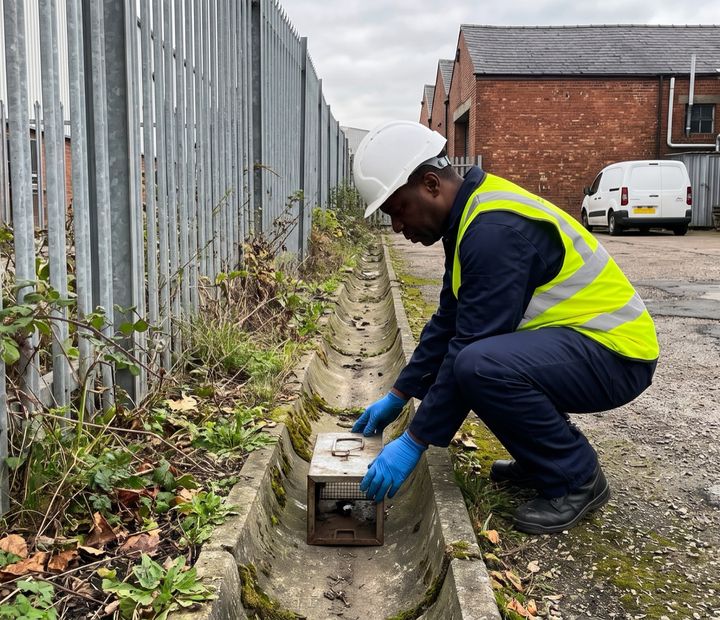
Northwest Environmental deals with rat and mouse problems in Wigan homes, flats and business premises, including Pemberton, Standish and Leigh. We survey, trace the entry route or drain defect, trap or bait in locked stations and proof the gaps over weekly visits. Wigan Council treats only its own tenants, so call us or use the form to book.
Why are Wigan’s rats so tied to the water?
Rats need water, cover and a reliable meal, and the canal, the river and the flashes each supply them in a different way. The Leeds and Liverpool Canal rises through the town by a flight of 21 locks, with the Leigh Branch running off through the Poolstock pair, and at Wigan Pier the water is used by anglers and leisure boaters. Banks soft enough to dig into, vegetation for cover and a steady scatter of bait, bread and takeaway scraps make the corridor a natural home for rats. When a garden backs onto the cut, the burrows we find tend to be under a shed, a compost bin or decking close to the boundary fence.
The River Douglas brings a sewer link into the picture. Close to Wigan North Western it is buried in a culvert under the tracks, and sewage reaching the river along much of its length is among the reasons given for its below-par water quality. Rats move freely through sewers and culverts, so in older streets near the river a rat that ignores bait in the garden is often living in the drain beneath it.
The subsidence lakes add a third setting. The Wigan Flashes cover 738 hectares of lakes and wetland and are now part of a National Nature Reserve, while Pennington Flash near Leigh has a 70-hectare lake. Homes on these edges can see field-margin rodents in the garden, and wood mice may move into sheds and outbuildings as autumn arrives.
What do we find in Wigan homes and premises?
Terraced streets are where mice cause the longest-running problems. Around Leigh’s centre the Victorian and Edwardian terraces are packed so closely that one roof space or floor void can serve several houses, so mice treated in one kitchen reappear next door. In older terraced property, back yards with clay drains bring rats into the mix, usually through a cracked joint or a disused connection.
Tower blocks behave differently. Scholes, just east of the town centre, has a council estate and a group of tower blocks, and in high-rise blocks generally mice use the vertical service routes and the bin stores at ground level. Converted mills such as Trencherfield, apartments since 2009, tend to have thick walls and long boxed-in service runs where mice can travel unseen between flats.
On the commercial side, town-centre shopping, from the Grand Arcade to the indoor market inside The Galleries, gathers many traders’ waste in one place, and a rat feeding at one bin store soon finds the rest. On a business park, Westwood Park included, the usual ways in for mice are incoming deliveries and roller doors left open while vehicles load.
What happens on a rodent visit in Wigan?
Because the council treats only its own tenants, most Wigan households and businesses book directly with us. From our Warrington base the town is around ten miles up the road, which lets us give the first visit a fixed day. It is a survey: we establish which rodent is involved, follow droppings and runs to where they are living, lift drain covers where the signs point underground and map every way in.
You then hear what we propose and why. Enclosed traps come first where children, pets or nearby wildlife make that the safer choice, which is often the case beside the flashes and the canal. Where bait is justified, it is sealed inside locked stations fixed along the active runs. Follow-up visits are about a week apart and are booked before we leave, so the dates are in your diary from day one. Proofing is done as we go, and once activity has stopped, all stations, traps and leftover bait are collected and a written summary follows. Businesses get the same summary in a form that can sit in their pest log.
How can you keep rodents out in Wigan?
Canal-side and riverside gardens benefit most from denying cover: lift clutter off the ground, bury mesh beneath sheds and decking, store bird seed in metal bins and keep compost closed. In terraces, talk to neighbours about treating at the same time and seal gaps where pipes pass through party walls. Flat owners and tenants should report sightings in communal areas to the managing agent quickly.
Businesses should keep bin store doors shut, fit brush strips to roller shutters and log every sighting. If building work starts near you, including as the Wigan Pier redevelopment continues, watch for fresh droppings and burrows in the weeks that follow, because disturbed ground pushes rats into the nearest buildings.
Rat & Mouse Control in Wigan: what we see locally
- Wigan Council's pest service is open only to its own housing tenants, and its booking page makes no provision for businesses, so owner-occupiers, private renters, landlords and firms arrange rodent treatment privately.
- The Leeds and Liverpool Canal climbs through the town by a flight of 21 locks, and its banks and towpaths give brown rats soft ground to burrow into and food dropped by walkers and anglers.
- The River Douglas passes through a culvert under the railway by Wigan North Western and receives sewage discharges along much of its length; culverts and sewers like these are the routes rats use to reach older drains.
- Around Leigh town centre, closely packed Victorian and Edwardian terraces let mice move between houses through shared roof and floor voids, so neighbouring homes often need treating together.
- Homes beside the Wigan Flashes and Pennington Flash sit next to protected wetland rich in wildlife, which is why we favour enclosed traps there and keep any bait locked away near buildings.
How we deal with it
- 1
Survey and identification
We confirm whether it is rats, house mice or wood mice, follow runs and droppings back to where they are living, and map the ways in, from airbricks and pipe entries to drains and door thresholds.
- 2
A plan you understand
We explain what we found, which method we recommend and why, where traps or stations will go, and anything you need to do first, such as clearing a cupboard or moving pet food and animal feed.
- 3
Trapping or secured baiting
Enclosed traps or tamper-resistant bait stations are fixed on the active runs and every position is recorded. Products are used strictly to their label and to the CRRU UK code of best practice.
- 4
Proofing and drain checks
Gaps are sealed or meshed and door brushes fitted where needed. If drainage is the source, we show you the defect and recommend a rat blocker or repair so the route is closed.
- 5
Follow-up visits
We return, usually about a week apart, to check activity, remove any carcasses, move stations or traps to where the rodents are now working and confirm the proofing is holding.
- 6
Close-out and report
When activity stops, every station, trap and scrap of bait is taken away, and you receive a written summary of what was found, what was done and what to watch for.
Rat & Mouse Control in Wigan: frequently asked questions
Mice keep coming back in our Wigan terrace. Do the neighbours need treating too?
Often, yes. In older terraced rows, such as those packed around Leigh town centre, mice cross from house to house through connected roof spaces, under-floor voids and openings around pipework in the party walls, so a home treated on its own is soon recolonised from next door. We map the runs in your house, show you where they lead and, with your agreement, contact the neighbours, a landlord or a letting agent so the row is treated and proofed in step. Sealing the openings on your own side still helps, whatever the neighbours decide.
Rats keep appearing from the canal behind our house. Can you treat the canal bank?
We treat and proof your own property and boundary, not the towpath or the bank, which are the waterway operator's responsibility, so report sightings there to them. On your side, we find where rats are crossing, set enclosed traps or locked stations along that line, and close the gaps that let them under sheds, decking and floors. Burying mesh along the fence line and removing spilt bird seed makes your garden far less appealing than the bank next to it.
Could the River Douglas be the reason rats are in our drains?
It could be part of the picture. Rats live in sewers and follow culverted watercourses, and the Douglas runs through a culvert by the railway near Wigan North Western. What actually lets them into a house, though, is nearly always a fault in the drain serving it: a cracked joint, a missing cap or a redundant branch left open. We lift the covers, look for droppings and smear marks in the chambers and show you where the defect is and which section of pipe it sits on, so the right person can repair it. Treating the garden without fixing the drain rarely holds.
Will building work at Wigan Pier push rats into nearby streets?
It can. A mixed-use plan for the pier, given approval in 2019, combines housing with a food hall and space for events, and in 2025 the council described the redevelopment as still in progress. Large groundworks of any kind break into burrows and old drains and send rats looking for the nearest food and shelter. If you live or trade near a site where work is under way, keep bins closed, check airbricks and the bottoms of doors, and look for fresh droppings or burrows over the following weeks. Reporting activity early means a short treatment rather than a settled colony.
Will rats leave on their own if I ignore them?
Rarely. While a building offers food, water and somewhere warm to nest, rats have no reason to move on, and they breed quickly: a female can mate again within a day or so of giving birth, and her young can breed within two to three months. Left in a loft or wall cavity, rats gnaw cables, which is a fire risk, foul insulation and stored belongings, and find their way to the kitchen through service voids. A problem that starts with a few droppings in autumn is often much larger by spring.
Can I legally put rat poison down in my garden?
Only in the way the product label allows. Rodenticides sold to householders are authorised for particular uses, usually indoors or outdoors close to buildings, and many may only be used inside a tamper-resistant bait station. Laying bait loose on open ground, in a hedge or by a compost heap risks poisoning pets, hedgehogs and birds of prey, and using a product against its label conditions can be an offence. Stronger professional products and larger packs are restricted to certified users under the UK rodenticide stewardship regime. In a garden used by children, dogs or hens, trapping is often the safer route.
Why do I keep getting rats under my decking or shed?
Decking and sheds give rats dry, hidden ground to burrow into, and most gardens have food nearby: bird feeders, dropped seed, compost bins, pet food or a hen run. Across much of the North West, a canal, brook or railway embankment close by adds a steady supply of new arrivals. Treating the burrows clears the current group, but others will move in unless the food is removed and the space under the structure is closed with buried mesh or a solid edge. We check the drains as well, because a broken pipe under a patio is often the real source.
More in Wigan
Last updated: