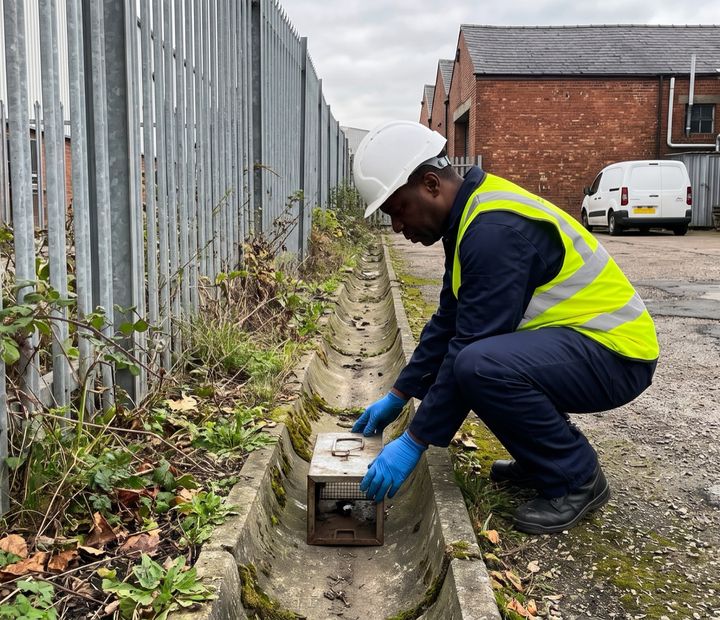
Rats and mice in St Helens, including Parr, Eccleston and Haydock, are dealt with by Northwest Environmental for homes and businesses alike. A technician surveys the property, checks the drains, places enclosed traps or lockable bait boxes, then returns about weekly until activity stops and the gaps are proofed. Ring us or use the website form to book.
Why are rats so tied to the water in St Helens?
Brown rats need water, cover and a steady food supply, and the town’s watercourses give them the first two in plenty, with gardens alongside providing the third. Sankey Brook splits Parr in two and Black Brook skirts it, and the Sankey Canal, still in water for most of its route, carries a towpath, a wetland and a string of fishing ponds up the Sankey Valley. In Eccleston, Mill Brook, Windle Brook and the banks of Eccleston Mere do the same job. Rats dig into soft banks, move under cover of the vegetation and come into gardens wherever a fence has a gap at the bottom.
Underground matters just as much. The council baits the public sewers in two six-week rounds a year, using complaint records and earlier baiting results to pick the busiest areas. Those rounds knock numbers down, but rats that survive, or that move in afterwards, still reach houses through defects in private pipework. When a cloudburst floods the system, as the borough’s surface-water flooding and Haydock’s flash floods have shown, rats are pushed up and out into whatever dry space they can find.
Railways add another set of corridors. Trains between Liverpool and Wigan stop at St Helens Central, and the Liverpool and Manchester Railway runs by St Helens Junction, Lea Green and Rainhill. Embankments and lineside scrub give rodents undisturbed ground that runs for miles behind back gardens.
What do we find in Parr, Haydock and the town centre?
In Parr’s older terraces, some dating from the 1890s, the culprit is usually old drainage: a cracked clay joint, a disused pipe left uncapped after a kitchen or bathroom was relocated, or a missing inspection cap. A rat can follow that route into a wall cavity or under a suspended timber floor without ever being seen outside. Mice behave differently, working through roof spaces and floor voids along the row, which is why one treated house in a terrace rarely stays clear unless its neighbours are involved.
On the 1950s and 1960s estates around Waring Avenue, Pennine Drive and Concourse Way, and on Haydock’s post-war estates beside the East Lancashire Road, the pattern is more often garden-led: burrows beneath sheds, decking and compost bins, followed by gnawing at airbricks or at gaps where services pass through the render.
In the town centre, the demolition that cleared the way for Phase 1A has disturbed old ground, and the plan to reopen the buried canal section will do the same again. Shops and food outlets nearby can expect rats to move in from the works if bins and back doors give them the chance.
How does a rat or mouse job run here?
We start with the survey: droppings, runs and smear marks followed to the nest or harbourage, and then the drains. Inspection covers are lifted to check for activity and damage, and if the fault lies in a shared sewer we set out what to report to the water company so the repair is made.
Treatment follows the evidence. Enclosed traps suit kitchens, homes with young children or pets, and gardens beside the brooks, where bait close to water needs extra care. Where rodenticide is justified, it is placed in secured, tamper-resistant boxes along the runs the rats are using. We come back about a week apart until activity stops, proof the entry points and take away everything we brought.
On commercial sites, particularly the distribution centres near M6 junction 23 and Florida Farm, the Haydock trading estates and the retail parks, monitoring points go at dock doors, along the building line and around bin compounds, and each visit is written up for your audit file.
Why do mice come in from the fields around Rainford?
Rainford is a pocket of homes in open arable country, with a few livestock herds. When the fields are cut and the weather cools, wood mice and house mice look for shelter in barns, garages and kitchens, and rats gather wherever feed is stored. Work on farms and smallholdings here means protecting animals, working dogs and wild birds as well as clearing rodents, so we rely on trapping and carefully sited stations, and baiting ends when the problem does.
What helps most in St Helens?
Report rats to the council even after a private treatment, since complaints decide where sewer baiting goes next. Check that drain covers are still seated after any heavy storm, and have the drains looked at if the garden has flooded. If your garden backs on to a brook or the canal, bury mesh along the fence line and keep bird food off the ground. Businesses near Church Square or on the retail parks should keep bin lids closed and bin stores swept, especially while building work carries on nearby.
Rat & Mouse Control in St Helens: what we see locally
- Parr is split by Sankey Brook and edged by Black Brook, and gardens near either, or near the water-filled Sankey Canal, are where we most often find burrows under sheds, decking and compost bins.
- In Eccleston, Mill Brook, Windle Brook and the banks of Eccleston Mere give rats a second network of waterside routes into back gardens.
- Surface-water flooding after heavy rain, including the flash floods that have covered main roads in Haydock, drives rats out of sewers and burrows and into garages, sheds and floor voids.
- Distribution centres near M6 junction 23 and Florida Farm, and the trading estate where Old Boston Colliery once stood, take in pallets all day, so monitoring points go at dock doors and along the building line.
How we deal with it
- 1
Survey and identification
We confirm whether it is rats, house mice or wood mice, follow runs and droppings back to where they are living, and map the ways in, from airbricks and pipe entries to drains and door thresholds.
- 2
A plan you understand
We explain what we found, which method we recommend and why, where traps or stations will go, and anything you need to do first, such as clearing a cupboard or moving pet food and animal feed.
- 3
Trapping or secured baiting
Enclosed traps or tamper-resistant bait stations are fixed on the active runs and every position is recorded. Products are used strictly to their label and to the CRRU UK code of best practice.
- 4
Proofing and drain checks
Gaps are sealed or meshed and door brushes fitted where needed. If drainage is the source, we show you the defect and recommend a rat blocker or repair so the route is closed.
- 5
Follow-up visits
We return, usually about a week apart, to check activity, remove any carcasses, move stations or traps to where the rodents are now working and confirm the proofing is holding.
- 6
Close-out and report
When activity stops, every station, trap and scrap of bait is taken away, and you receive a written summary of what was found, what was done and what to watch for.
Rat & Mouse Control in St Helens: frequently asked questions
The council baits the sewers every February and November. Do I still need my own treatment?
Many councils run a pest control service for residents, but what is covered, who can book and the charges all vary and can change, so check the council's own pest control pages before you book. If you rent, report the problem to your landlord first. If you would rather book a private firm, call or message us to arrange a visit.
Our garden backs on to Sankey Brook. Can you stop rats crossing from the bank?
We can make your side much harder to cross, although the bank itself will always hold some rats. We look for the crossing point, usually a gap under the fence or a shed or deck near the boundary, and treat close to the water with enclosed traps, because bait beside a watercourse needs particular care. Then we bury fine mesh along the base of the fence, close off the space beneath the shed and decking, and seal any gaps into the house. Feeding birds from a tray instead of scattering seed removes the main attraction.
Our terrace in Parr has mice and so do the neighbours. Is treating one house worth it?
It helps, but the result lasts longer if the row is dealt with together. Mice in terraced streets travel through shared roof spaces, floor voids and the gaps around pipes that pass between houses, so a home treated on its own is often re-entered from next door within weeks. If your neighbours agree, we survey each house, place traps or stations where the runs cross and proof the gaps in party walls and around services. Where the homes belong to a housing provider, ask them to arrange a treatment for the whole block.
I cannot tell rats from mice by the droppings. What should I send before booking?
Send us a clear photo of the droppings next to a coin, along with any gnawing or holes you have found. Rat droppings are around a centimetre or more long with blunt ends, while mouse droppings are much smaller and pointed. Check St Helens Borough Council's website for current pest control services and charges. Wear gloves if you need to clear droppings, and keep children and pets away from them.
Will rats leave on their own if I ignore them?
Rarely. While a building offers food, water and somewhere warm to nest, rats have no reason to move on, and they breed quickly: a female can mate again within a day or so of giving birth, and her young can breed within two to three months. Left in a loft or wall cavity, rats gnaw cables, which is a fire risk, foul insulation and stored belongings, and find their way to the kitchen through service voids. A problem that starts with a few droppings in autumn is often much larger by spring.
Can I legally put rat poison down in my garden?
Only in the way the product label allows. Rodenticides sold to householders are authorised for particular uses, usually indoors or outdoors close to buildings, and many may only be used inside a tamper-resistant bait station. Laying bait loose on open ground, in a hedge or by a compost heap risks poisoning pets, hedgehogs and birds of prey, and using a product against its label conditions can be an offence. Stronger professional products and larger packs are restricted to certified users under the UK rodenticide stewardship regime. In a garden used by children, dogs or hens, trapping is often the safer route.
Why do I keep getting rats under my decking or shed?
Decking and sheds give rats dry, hidden ground to burrow into, and most gardens have food nearby: bird feeders, dropped seed, compost bins, pet food or a hen run. Across much of the North West, a canal, brook or railway embankment close by adds a steady supply of new arrivals. Treating the burrows clears the current group, but others will move in unless the food is removed and the space under the structure is closed with buried mesh or a solid edge. We check the drains as well, because a broken pipe under a patio is often the real source.
More in St Helens
Last updated: