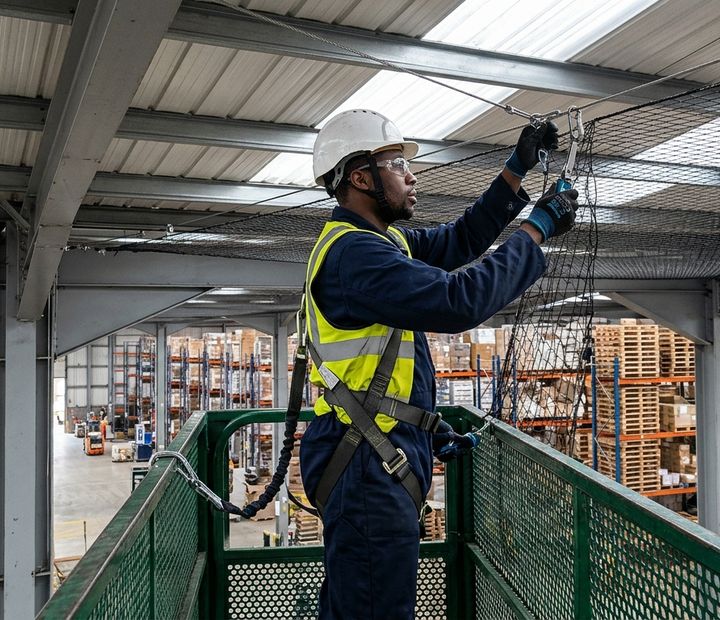
Northwest Environmental proofs Liverpool homes and businesses against pigeons and gulls, from terraced streets to city-centre venues, docks and Speke business parks. A survey confirms the species and any nest in use; we then fit netting, spikes, wire or mesh within wildlife law, on dates planned from our Warrington base. To book, phone or use the contact form.
Why do gulls and pigeons settle on Liverpool buildings?
Liverpool faces the Wirral across the Mersey Estuary, and gulls that feed along the river use the city’s roofs as substitute cliffs. A Liverpool John Moores University researcher in animal behaviour makes that comparison and names litter and food waste as the reason gulls stay, which fits what our surveys find: a flat or shallow roof, a parapet for shelter, and a takeaway, bin store or set of outdoor tables a short flight away. Complaints from shoppers and people working in the centre about stolen food and swooping birds have become more common, and the calling is loudest from late spring into early summer, when eggs and chicks are on the roofs.
Feral pigeons want something else: deep ledges, cornices, arches and dry voids. The city’s older stock supplies plenty: over 2,500 buildings here are listed, and 27 of those are Grade I. The last stretch of the Leeds and Liverpool Canal, from the Eldonian Basin down the four Stanley Dock locks to the tunnels at the Pier Head, adds the kind of dry canal-side structure pigeons look for. Because pigeons breed in any month, a roost left alone tends to become a nesting colony.
What do we find on Liverpool homes?
Across the north and east of the city, terraced streets remain the main housing, and on these roofs trouble usually starts where slates meet the gutter or the party wall. A loose fascia, a slipped slate or a gap behind a gutter bracket lets pigeons nest in the eaves, and sparrows and starlings need even less room. Bins matter as much as roofs. Where rubbish is kept in a back alley, or at one of the 850 or so communal bin stations the council introduced for households with little alleyway space, a lid left up is enough to draw gulls down into the street.
About a third of Liverpool’s housing was privately rented in 2021, approaching half in a number of wards, so many domestic jobs are arranged through a landlord or letting agent. Newer homes bring the high-rise version of the problem. Apartment blocks on Wolstenholme Square, student and young-professional housing in the Baltic Triangle and the 13 older tower blocks that were kept and refurbished can all mean pigeons on balconies, gulls nesting beside roof plant and droppings on ledges several storeys up.
Which Liverpool businesses see the most bird trouble?
In the centre, food and drink venues tend to feel it first. The Ropewalks, taking in Bold Street, Duke Street and the outdoor drinking of Concert Square, and the Baltic Triangle, with its markets, beer gardens and live-music venues, put people eating outdoors within reach of any gull nesting on a nearby roof. Pigeons roost under canopies, signs and fire escapes and foul the doorways below.
Along the river, the dock estate stretches from Brunswick Dock up to Seaforth, where grain is handled alongside containers, and spilt grain keeps pigeons returning to a site for as long as it lies there. Speke combines Liverpool John Lennon Airport with Estuary Commerce Park, Speke Business Park on Goodlass Road, New Mersey Shopping Park and a cluster of pharmaceutical sites, and roofs of that kind give gulls wide, undisturbed nesting space. In the Knowledge Quarter, the Royal Liverpool University Hospital, the two universities and the phased building work at Paddington Village mean proofing has to be timed around patients, students and staff.
How does a bird-proofing job run in Liverpool?
Every job starts on site. We confirm the species, how they use each part of the building, whether any nest is occupied and whether fixings would sit in stone, brick or render. Access in the centre needs early planning, because a tower or platform standing on the pavement may need a licence from the highway authority, and a listed building or conservation area may need consent before anything is fixed to it.
You then receive a specification with photographs, and business premises also get a method statement for facilities managers, landlords or managing agents to approve. The law sets the timetable. The Wildlife and Countryside Act 1981 protects all wild birds, along with their eggs and any nest that is occupied or under construction. Herring gulls are red-listed and fall outside the general licences, so removing an occupied gull nest needs an individual licence from Natural England. In practice we survey gull roofs from autumn and fit over winter. Dates are planned from our Warrington base, and for venues and shops we work around opening hours.
How do you keep birds off once the proofing is in?
Take away the food as well as the ledges. On a terrace that means the household bin and the alley; at a venue it means the outdoor tables and the bin store. Keep lids shut, including at communal bin stations, clear tables quickly and discourage anyone from feeding gulls or pigeons. Check netting and wires after winter storms and report damage early, because a torn section soon lets birds back in. Those bins and scraps feed rats too, so on many Liverpool sites we pair bird proofing with rodent control.
Bird Control & Proofing in Liverpool: what we see locally
- Terraced streets are still the main housing across the north and east of Liverpool, so domestic bird work there is mostly about closing gaps at eaves, gutters, party walls and chimney stacks before pigeons, starlings or sparrows reach the roof space.
- In the city centre the complaints are about food being snatched and people being swooped on, so at venues in the Baltic Triangle and the Ropewalks we look first at the flat roofs and parapets nearest the outdoor tables and bin stores.
- More than 2,500 of the city's buildings are listed, from St George's Hall to the Pier Head's Three Graces, so we confirm a building's listed status before specifying any fixings on an older frontage.
- The broad roofs of the dock estate, which reaches from Brunswick Dock up to Seaforth, and of the business parks and shopping park around the airport at Speke are where gull proofing usually has to be planned over the winter months.
- Because Liverpool's gulls are at their loudest from late spring into early summer, we start roof surveys in autumn and aim to finish fitting before the pairs return to nest.
How we deal with it
- 1
Site survey
We identify the species, what the birds are doing in each area, where any active nests are, what the fixings would go into and how the work can be reached safely.
- 2
Written specification
You receive photographs and a plan for each area: the system, mesh size, access method and timing, plus a risk assessment and method statement for business premises.
- 3
Timing around nests
Any area with an active nest waits until the young have left; the rest can go ahead. For gulls we aim to finish the roof before the next breeding season starts.
- 4
Clearance and installation
Empty nests and fouling are damped down, bagged and the surface disinfected. We check no birds are inside, then fit the netting, spikes, wire, gel or panel mesh.
- 5
Handover and upkeep
You get a record of what was fitted and where, including the access points in any netting, and we can return to inspect fixings periodically and after storms.
Bird Control & Proofing in Liverpool: frequently asked questions
Does Liverpool City Council deal with pigeons or gulls on houses?
Not through its domestic pest service, which lists rats, mice, wasps and ants, so pigeons in the eaves or gulls on a roof fall outside it. The council also has a separate commercial service for landlords, schools and businesses that quotes after a survey; if you are a landlord or business, ask the council directly whether bird work is part of it. For most homes the fix that lasts is proofing the building itself, which is the work we survey for and fit across the city.
Starlings or sparrows are getting in under the eaves of our terraced house. Can you seal the gap?
Yes, once any nest behind it is empty. Like every wild bird, both are protected, and both are red-listed as species of high conservation concern, so an opening with eggs or chicks inside is left until the young have flown. That usually takes a few weeks, although sparrows can raise more than one brood in a season. We then clear the old nest material, check the roof space and close the opening with an eaves comb, mesh or a repair that suits the slate and gutter line. On a terrace we look along the neighbouring eaves too, because birds shut out of one house often move next door.
Do we need permission to fit bird proofing to a listed building in Liverpool?
Possibly. Listed building consent is needed for works that affect a listed building's character, and doing such work without consent is an offence. In a city with over 2,500 listed buildings, the question comes up often. Small, reversible fixings are less likely to need consent than netting across a facade, but the decision rests with the local planning authority, not with us. We check the listing and whether the building sits in a conservation area before we specify anything, and we can supply drawings and photographs to support an application.
Gulls keep taking food from customers at our outdoor tables. Will proofing the roof stop it?
It helps, but it will not solve the problem on its own. Proofing stops gulls nesting and resting on your building, which removes the pair that defends your patch each summer and the birds watching your tables from the parapet. Gulls also fly in from roofs nearby, so the food has to go as well: clear plates and leftovers promptly, use lidded bins outside, keep the bin store shut and ask staff not to throw scraps. In busy spots such as Concert Square or the Baltic Triangle, it pays for neighbouring venues to tackle this together.
Can you proof balconies and roofs on a block of flats or a student building?
Yes. On apartment blocks we usually work for the managing agent or freeholder, because roofs, plant areas and facades are normally common parts. Because roughly one Liverpool home in three is privately rented, the request often reaches us through a letting agent rather than the resident. Pigeons on balconies are dealt with by netting the balcony opening or fitting spikes or wire to rails and ledges, with access arranged with each resident. Roof plant and parapets on taller buildings need suitable access equipment, and the agent receives a written specification and method statement to approve before any work starts.
Can you remove gulls nesting on our warehouse roof?
Not while the nest is in use, unless Natural England has issued a licence. Herring gulls and lesser black-backed gulls are not covered by the general licence for public health and safety, so taking a nest that is being built or holds eggs or chicks needs an individual licence. These are normally granted only where there is evidence of a real risk to people's health or safety, not for noise, mess or damage to a building. Once the young have fledged and the nest is empty, it can be cleared. The lasting answer is to proof the roof over autumn and winter so gulls find nowhere to nest next spring.
When is the best time of year to gull-proof a roof?
Between breeding seasons: broadly from late summer, once chicks have fledged, through to early spring. Gulls pair up and start building on roofs in spring, and from then until the young leave an active nest limits what can be done near it. Booking a survey in autumn leaves time to plan access, agree a method statement with your facilities team or landlord and fit the system before the birds come back. If gulls are already nesting, we can still survey, proof the parts of the roof well away from the nest and return for the rest once it is empty.
Is it legal to get rid of pigeons, and can I shoot them in my garden?
Keeping pigeons off a building with proofing is lawful as long as no bird is harmed or trapped and no active nest is destroyed. Killing feral pigeons or taking their nests needs a licence. Around homes and other buildings the relevant one is usually Natural England's general licence GL41, which the owner or occupier, or someone they authorise, may use only for its listed purposes: preventing slips and falls, the spread of disease to people and safety problems caused by nesting. Pigeons eating bird seed or sitting on a fence do not fit those purposes, and firearms law and safety apply too. In a built-up street, proofing the roof and removing the food source is the realistic route.
More in Liverpool
Last updated: