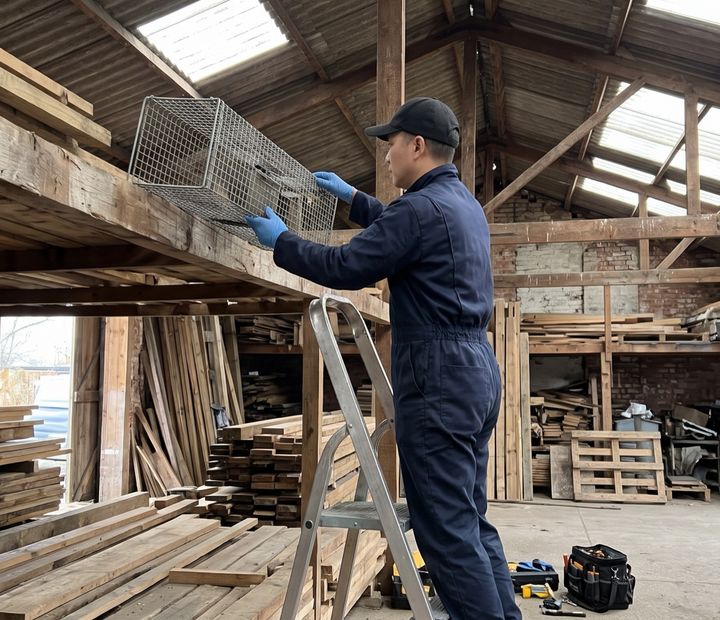
Grey squirrels in lofts, roof voids, barns and outbuildings across Stockton Heath, Grappenhall and Thelwall are removed by Northwest Environmental. After a roof survey we set traps checked every day, deal with any grey caught as the law requires and seal the way in, usually within one to two weeks. Phone us or send the contact form to book.
Why do grey squirrels end up in roofs around Stockton Heath?
Grey squirrels need trees for food and cover, and they treat a roof as just another branch. This corner of WA4 has a good deal of green space close to houses. The formal gardens at Walton Hall, the walled garden at Grappenhall Heys and Alexandra Park sit among the streets, the golf club takes up the top of Appleton, and the green belt reaches in around Appleton Reservoir. Bird feeders in private gardens add a reliable meal, and a squirrel that has learned a garden will soon be testing the roof above it.
The houses themselves help. With a dozen listed buildings in Stockton Heath and 30 more across Grappenhall and Thelwall parish, the homes among them include brick cottages, a Gothic rectory and 17th-century farmhouses. Roofs of that age tend to have timber eaves that soften over time, and a loft that nobody goes into for months is exactly the dry, quiet space a squirrel looks for when the weather turns.
What do we find in older lofts and outbuildings here?
In older brick cottages like those on London Road, the way in is usually high up: a gnawed corner where the fascia meets the gutter, a softened bargeboard, or a gap where a tile has slipped. On rendered and stuccoed houses, such as those near St Wilfrid’s, the weak point is often the junction between the render and the roof timbers. Inside, we typically find a heap of dry leaves, twigs and torn-up insulation tucked against a chimney breast or a gable wall, with runs worn across the joists and droppings along them.
Thelwall’s timber-framed farmhouses and barns are another matter. Old beams, open eaves and stored materials give squirrels many ways in and plenty to chew, and a barn can hold several nest sites at once. These are also the buildings most likely to shelter bats or nesting birds, so the survey has to account for both before any trap is set or hole closed.
Why does the council route not apply?
Many councils run a pest control service for residents, but what is covered, who can book and the charges all vary and can change, so check the council’s own pest control pages before you book. If you rent, report the problem to your landlord first. If you would rather book a private firm, call or message us to arrange a visit.
How does a squirrel job run in Stockton Heath and Grappenhall?
The first visit is a survey. We walk round the outside of the property to spot each gap and each climbing route, whether that is a tree, a climbing plant, a fence or a flat garage roof, and then inspect the loft. You get a plain explanation of where traps will go, how often they will be checked and what happens to any squirrel caught.
Traps are set along the paths the squirrels use in the roof space or up on the roof, and they are checked every day, weekends included, on a rota we agree with you at the start. Once checks show no fresh activity, every entry point is closed using galvanised steel mesh, sheet metal or new timber, and the soiled insulation and nest material are bagged and taken away. A final visit confirms that the proofing is holding. Most homes here are finished within one to two weeks; barns, several entry points or young in the nest can stretch that.
Proofing listed and conservation-area homes
Proofing is where the area’s history matters most. Repairs to the fabric of a listed building can need consent, so we keep to materials that match what is there and use fixings a future owner could take out without harming the wall. In the conservation area around the village centre, cutting back a tree that gives squirrels a route onto the roof normally needs six weeks’ notice to the council, and in spring and summer any nesting birds in it must be left alone. Each autumn, check the eaves for new chew marks, which will catch a returning squirrel before it gets back in.
Squirrel Removal in Stockton Heath & Grappenhall: what we see locally
- Parkland and gardens at Walton Hall, the walled garden at Grappenhall Heys, Alexandra Park and the golf course up at Appleton give grey squirrels green space right beside the surrounding streets.
- Thelwall's 17th-century farmhouses and the listed barns at Home Farm and Old Village Farm have roof voids and outbuildings that squirrels can get into and that bats may also use, so we check for both before anything is sealed.
- Repairs to chewed fascias or eaves on the area's Grade II listed cottages and houses can need listed building consent, so proofing on those properties is planned with that in mind.
How we deal with it
- 1
Roof and loft survey
We trace every hole and climbing route from outside, then check the loft for the nest, how many squirrels are using it, damage to timber and cables, and any sign of bats or nesting birds.
- 2
A plan explained plainly
We set out where traps will go, how the daily checks will be covered, what the law requires for any grey squirrel caught, and anything you need to do first, such as clearing access to the loft hatch.
- 3
Trapping, checked every day
Cage traps, or spring traps approved for grey squirrels and set as their approval requires, go on the runs in the roof space and are checked at least once a day. Greys are humanely dispatched; a red squirrel would be released unharmed.
- 4
Proofing the way in
Once the loft is clear, entry points are closed with galvanised mesh, metal sheet or new timber, and chewed fascias, soffits and vents are repaired so another squirrel cannot reopen them.
- 5
Clean-up and checks
Nest material and soiled insulation are bagged and removed, and any gnawed cables are pointed out so an electrician can test them before the loft is used again.
- 6
Follow-up and report
We return to confirm there is no fresh activity and the proofing is holding, then send a written summary of what was found, caught and repaired.
Squirrel Removal in Stockton Heath & Grappenhall: frequently asked questions
Will Warrington Borough Council remove squirrels from my loft in Stockton Heath?
Many councils run a pest control service for residents, but what is covered, who can book and the charges all vary and can change, so check the council's own pest control pages before you book. If you rent, report the problem to your landlord first. If you would rather book a private firm, call or message us to arrange a visit.
My cottage is listed or sits in the conservation area. Does that change the job?
It changes the proofing more than the trapping. Traps sit in the loft and leave no mark, but closing the way in afterwards means working on fascias, eaves or old timber, and alterations to a listed building can need consent. We match repairs to the existing materials where we can, choose fixings that could be taken off again, and flag anything that should go past the council first. If the squirrels' route onto the roof is a tree in the conservation area, pruning normally needs six weeks' notice to the council.
Can you clear squirrels from a barn or stable in Thelwall?
Yes. Outbuildings are often harder than houses, because barns and stables have more openings, open eaves, and stored feed or bedding that squirrels raid and nest in. We survey the whole building, set traps where animals, children and visitors cannot reach them, and agree who will be on site for the daily checks. Old timber-framed and brick barns can also hold roosting bats or nesting birds, both protected by law, so we look for them before planning any proofing.
Is there a best time of year to deal with squirrels in a Grappenhall loft?
Sooner is better, but the calendar affects how the job finishes. Greys tend to look for roof spaces as the weather turns in autumn, pregnant females want a sheltered spot from late winter, and many raise a second litter in summer. If dependent young are in the loft, we wait until they can move before the final seal rather than shut them in. Starting in autumn or early winter, before the first litters arrive, usually gives the cleanest run from trapping to proofing.
Can a squirrel be caught and released somewhere else?
Not if it is a grey squirrel. Greys are a listed invasive non-native species, and under the Invasive Alien Species (Enforcement and Permitting) Order 2019, as well as the Wildlife and Countryside Act 1981, it is an offence to release one or let it escape into the wild without a licence. That includes driving it to a wood a few miles away. A grey caught in a trap has to be humanely dispatched. Red squirrels are the opposite: they are protected, and one caught by mistake must be let go unharmed. Across most of our area a red in a loft is very unlikely; the Sefton coast and the countryside around it are the exception.
How can I tell whether it is squirrels or rats in my loft?
Timing is the best clue. Grey squirrels are active by day, so noise that starts around dawn and picks up again in the late afternoon points to squirrels, while scratching that begins after dark is more likely to be rats or mice. Squirrels usually get in high up, through a gnawed hole in the fascia or soffit near a tree or climbing plant, whereas rats tend to come up through wall cavities, drains or gaps low down. A bulky nest of leaves and shredded insulation is typical of squirrels. If you are unsure, a survey settles it before any traps go down.
Can I just block up the hole the squirrels are using?
Not while they are still inside. A squirrel shut into a loft will chew a new way out, sometimes through a ceiling into the house, and an animal left to starve suffers needlessly, which can be an offence under animal welfare law. From late winter to late summer there may also be young in the nest that cannot leave yet. Holes should be sealed only once the loft is clear, confirmed by checking for fresh activity, or in suitable cases after a one-way door has let the squirrels out. That is why proofing comes at the end of the job, not the start.
More in Stockton Heath & Grappenhall
Last updated: