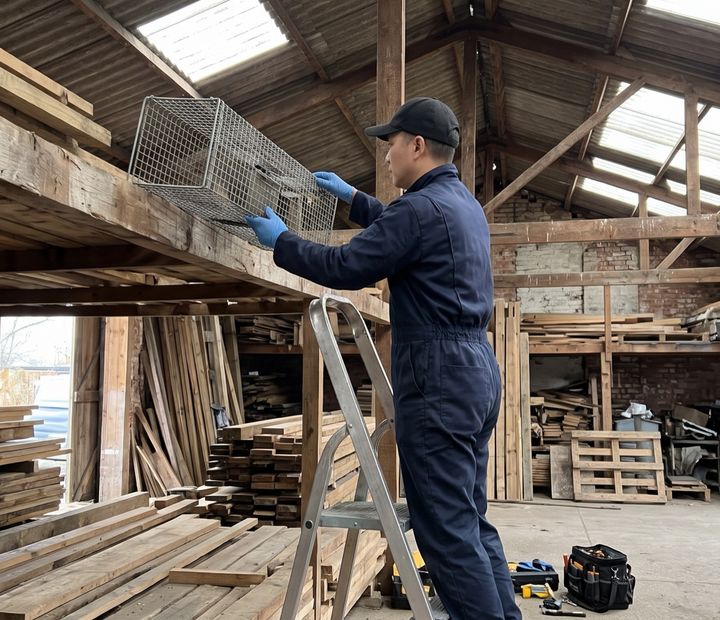
Northwest Environmental removes grey squirrels from lofts, roof voids and outbuildings across Cheshire, Merseyside, Lancashire and Greater Manchester, working out from Warrington. We survey the roof, trap and humanely dispatch the squirrels as the law requires, then proof the entry points, usually over one to two weeks. Call us or use the contact form to book.
What are the signs of squirrels in a loft or roof space?
Most people hear squirrels before they see them. Rats and mice work mainly at night, but grey squirrels are active in daylight, so the usual giveaway is scratching, scampering and heavy thumps above the ceiling soon after dawn, then again in the late afternoon. Some householders describe a rolling sound, which is often a nut or a cone being moved across the joists.
Other signs worth checking for:
- a hole in the fascia, soffit or barge board at the eaves, with gnaw marks around the edge, usually close to a tree, a climbing plant or a flat garage roof;
- squirrels using the same route each day along a fence, a cable or an overhanging branch to one point on the roof;
- shredded loft insulation, torn roofing felt and a bulky nest of leaves, twigs and paper in a corner or behind the water tank;
- gnawed timber, pipe lagging, stored boxes or cables;
- droppings and urine stains, sometimes showing through a bedroom ceiling;
- on business premises, debris dropping from ceiling tiles or noise above a suspended ceiling in an office, classroom or stockroom.
If the noise starts after dark and the gaps are low down, near drains or airbricks, rats are more likely, and our rat and mouse control service is the better starting point.
Why are squirrels such a problem across the North West?
Grey squirrels do best wherever mature trees meet houses with gardens, and a great deal of our area fits that description. The leafy villages and suburbs of north Cheshire, including those strung along the Bridgewater Canal south and east of Warrington, have plenty of older detached and semi-detached houses with timber eaves, mature trees in the garden or the lane, and lofts that are rarely visited. Larger properties often add garages, garden rooms and outbuildings, each one another roof to get into. To the south-west, around Delamere Forest and the wooded farmland of mid Cheshire, greys can also move into farm buildings and village homes, and they strip bark from young broadleaf trees in late spring and early summer, which matters to estate and woodland owners.
Merseyside is a mixed picture. Parks and tree-lined suburbs carry plenty of greys, while the Sefton coast around Formby is one of the few places in England where red squirrels still live. Greys can carry squirrelpox without showing symptoms, but it kills reds, and Lancashire Wildlife Trust reported an outbreak on the Sefton coast in 2026. Anywhere near that coast, how greys are controlled, and what is left out for them to eat, matters more than usual.
In Lancashire and the western boroughs of Greater Manchester, the older terraced streets of the mill towns tend to see fewer squirrels in the loft than the suburbs, but houses backing onto parks, cemeteries, golf courses, wooded valleys and railway embankments are a different matter. Schools, care homes, offices and business parks set in landscaped grounds often have trees planted close to the walls, giving squirrels a direct route onto the roof.
The calendar matters too. In autumn, squirrels look for dry, warm winter quarters, and a loft beats a drey in a tree. From late winter, females look for somewhere safe to have their first litter, and many have a second in summer. A loft can therefore hold dependent young for much of the year, which shapes when the way in can be sealed.
How do we get squirrels out of a loft?
Every job starts with a survey. We look at the roof from outside to find every hole and every route up, then inspect the loft to judge how many squirrels are using it, where the nest is and what has been damaged. We also look for bats and nesting birds. Both are protected, and either can change what is sealed and when.
We then explain the plan in plain terms. In most lofts that means cage traps, or spring traps approved for grey squirrels, set on the runs in the roof space or on the roof. Traps should be checked at least once a day, and we treat that as a minimum, so before anything is set we agree how the checks will happen, weekends included. Where red squirrels could be about, we use live-capture traps only, so that a red caught by mistake can walk away unharmed.
Any grey squirrel caught is humanely dispatched by our technician. Releasing a grey into the wild is an offence, including letting it go in a wood a few miles away, because the grey is a listed invasive species. We say this at the outset, because many people reasonably expect catch and release. Where the squirrels have only just found a way in and there are no young, a one-way door over the main hole can sometimes let them leave without returning, with the other gaps sealed first.
When checks show no fresh activity, we proof every entry point with galvanised mesh, metal sheet or new timber, and repair fascias, soffits, barge boards and vents. Nest material and soiled insulation are bagged and removed, and any chewed cables are pointed out for an electrician to test.
Is squirrel removal safe around children, pets and staff?
No poison is used. Nothing is currently authorised for squirrels, and putting rat bait down for them breaks the terms of the product as well as endangering pets, birds of prey and red squirrels. Nor do we use glue traps: in England, setting one to catch any rodent, squirrels included, is an offence without a licence under the Glue Traps (Offences) Act 2022.
Traps go in the loft or on the roof, away from children, pets and the people who use the building. In schools and care homes, loft hatches are kept locked and only our technicians handle traps. Dispatch is quick and out of sight; drowning a trapped squirrel is cruel and can be an offence. Please do not handle a squirrel yourself, as a cornered one can bite hard.
How many visits does squirrel removal take?
Most homes need a survey and set-up visit, daily trap checks over roughly one to two weeks, a proofing visit once the loft is clear and a final check. Several entry points, young in the nest, roofs that need a tower or platform, and large or occupied commercial buildings can all add time. If young are present, we wait until they can leave the nest rather than sealing them in.
How do you stop squirrels getting back in?
Proofing does most of the work, but squirrels test a roof repeatedly. Cut back branches and climbing plants close to the roof, after checking with your council whether the tree is protected and looking for nesting birds in spring and summer. Use a squirrel-resistant bird feeder, or none at all; near the Sefton coast, follow Lancashire Wildlife Trust’s current advice on garden feeders, which bring squirrels together and can help spread squirrelpox. Each autumn, look along the eaves for fresh gnawing, and have damaged fascias repaired quickly, because a softened board is easier to chew through.
When does DIY squirrel control stop being enough?
Deterrent sprays, ultrasonic devices and lights left on in the loft rarely move a settled squirrel for long. An owner or occupier can trap greys, but you then have to check the trap at least once a day and dispatch what you catch humanely, which many people are not prepared to do, and releasing it is not an option.
Get help if you cannot reach the entry holes safely, if there are young in the loft, if cables have been chewed, if there are signs of bats or nesting birds, or if the roof is shared, as in flats and terraces. Check with your council too: some in our area deal with squirrels and others do not, and the council duty under the Prevention of Damage by Pests Act 1949 covers rats and mice, not squirrels.
What should landlords and businesses keep on record?
For landlords, gnawed fascias and gaps in the roof are usually repair matters under section 11 of the Landlord and Tenant Act 1985, and pests can be assessed under the Housing Health and Safety Rating System. Who pays depends on the tenancy and the cause, so keep the survey, the proofing record and photographs of the repairs.
For businesses, keep the survey, a log of daily trap checks, catches, entry points found and proofing carried out. Food businesses have a duty to control all pests, not only rats and mice, under the Food Safety Act 1990 and the Food Safety and Hygiene (England) Regulations 2013, so file the record with your HACCP or Safer Food Better Business paperwork. For schools, care homes and offices, it belongs in the property file, alongside any electrical checks.
How we deal with it
- 1
Roof and loft survey
We trace every hole and climbing route from outside, then check the loft for the nest, how many squirrels are using it, damage to timber and cables, and any sign of bats or nesting birds.
- 2
A plan explained plainly
We set out where traps will go, how the daily checks will be covered, what the law requires for any grey squirrel caught, and anything you need to do first, such as clearing access to the loft hatch.
- 3
Trapping, checked every day
Cage traps, or spring traps approved for grey squirrels and set as their approval requires, go on the runs in the roof space and are checked at least once a day. Greys are humanely dispatched; a red squirrel would be released unharmed.
- 4
Proofing the way in
Once the loft is clear, entry points are closed with galvanised mesh, metal sheet or new timber, and chewed fascias, soffits and vents are repaired so another squirrel cannot reopen them.
- 5
Clean-up and checks
Nest material and soiled insulation are bagged and removed, and any gnawed cables are pointed out so an electrician can test them before the loft is used again.
- 6
Follow-up and report
We return to confirm there is no fresh activity and the proofing is holding, then send a written summary of what was found, caught and repaired.
Typical visits: Usually a survey and set-up visit, daily trap checks over roughly one to two weeks, a proofing visit once the loft is clear and a final check. Several entry points, young in the nest, high or awkward roofs and large commercial buildings can all extend this.
Safety: No poison is used, because none is authorised for squirrels. Traps sit in the loft or on the roof, out of reach of children, pets and staff, and are checked at least daily. We look for bats and nesting birds before sealing anything, never seal a live squirrel in, and flag chewed wiring for an electrician. We do not use glue traps.
Squirrel Removal: frequently asked questions
Can a squirrel be caught and released somewhere else?
Not if it is a grey squirrel. Greys are a listed invasive non-native species, and under the Invasive Alien Species (Enforcement and Permitting) Order 2019, as well as the Wildlife and Countryside Act 1981, it is an offence to release one or let it escape into the wild without a licence. That includes driving it to a wood a few miles away. A grey caught in a trap has to be humanely dispatched. Red squirrels are the opposite: they are protected, and one caught by mistake must be let go unharmed. Across most of our area a red in a loft is very unlikely; the Sefton coast and the countryside around it are the exception.
How can I tell whether it is squirrels or rats in my loft?
Timing is the best clue. Grey squirrels are active by day, so noise that starts around dawn and picks up again in the late afternoon points to squirrels, while scratching that begins after dark is more likely to be rats or mice. Squirrels usually get in high up, through a gnawed hole in the fascia or soffit near a tree or climbing plant, whereas rats tend to come up through wall cavities, drains or gaps low down. A bulky nest of leaves and shredded insulation is typical of squirrels. If you are unsure, a survey settles it before any traps go down.
Can I just block up the hole the squirrels are using?
Not while they are still inside. A squirrel shut into a loft will chew a new way out, sometimes through a ceiling into the house, and an animal left to starve suffers needlessly, which can be an offence under animal welfare law. From late winter to late summer there may also be young in the nest that cannot leave yet. Holes should be sealed only once the loft is clear, confirmed by checking for fresh activity, or in suitable cases after a one-way door has let the squirrels out. That is why proofing comes at the end of the job, not the start.
What damage can squirrels do in a roof space?
More than most people expect. Squirrels gnaw constantly, and in a loft that means timber, roofing felt, pipe lagging, stored boxes and, most seriously, electrical cables, where chewed insulation is a fire risk. They flatten and shred loft insulation to build nests, and urine and droppings can stain ceilings below. Outside, they chew fascias and soffits to widen the way in, which lets rain in too. In offices, schools and care homes, noise and falling debris above a suspended ceiling is often the first thing reported. If any cables have been gnawed, have an electrician check them.
Can you use poison to get rid of squirrels?
No. No poison is currently authorised for use against squirrels in the UK. The warfarin bait once permitted for grey squirrels in woodland has not been allowed since 2015, and rat and mouse baits are authorised for rats and mice only, so putting them down for squirrels breaks the conditions of the product. Poison would also leave a squirrel to die somewhere in the roof, causing a smell and drawing flies, and it puts pets, birds of prey and, near the Sefton coast, red squirrels at risk. Trapping followed by proofing is the lawful and reliable route.
Will cutting back trees stop squirrels getting onto my roof?
It helps, but it is rarely enough on its own. Grey squirrels jump well, so branches close to or over the roof give them an easy route, and so do climbing plants, fences and cables. Cutting back overhanging limbs takes pressure off the proofing. Before you prune, ask your council whether the tree has a Tree Preservation Order or stands in a conservation area, because work on protected trees may need consent or advance notice. In spring and summer, check for nesting birds as well, since an active nest is protected by law.
I rent my home. Is squirrel removal my landlord's job?
Often, though it depends on the tenancy and the cause. Under section 11 of the Landlord and Tenant Act 1985, landlords of most residential lets must keep the structure and exterior in repair, and gnawed fascias, broken soffits or gaps in the roof that let squirrels in usually fall within that. Pests are also one of the hazards a council can assess under the Housing Health and Safety Rating System, and the Homes (Fitness for Human Habitation) Act 2018 gives tenants a route to act if a home is unfit. Report the problem to your landlord in writing and keep a copy.
Can you deal with squirrels at a school, office or care home without disrupting it?
Yes, with planning. Most of the work happens in the roof space or on the roof, so we agree access routes, loft hatch keys and visit times that avoid lessons, residents' rest or busy trading periods, and we can work early or late where that suits. Traps go where only our technicians can reach them, and we agree in writing who checks them each day, including weekends and holidays. Proofing at height is planned under a risk assessment with an exclusion zone below. You receive a record of trap positions, catches, entry points and repairs for your property file.
Squirrel Removal by county and town
Last updated: