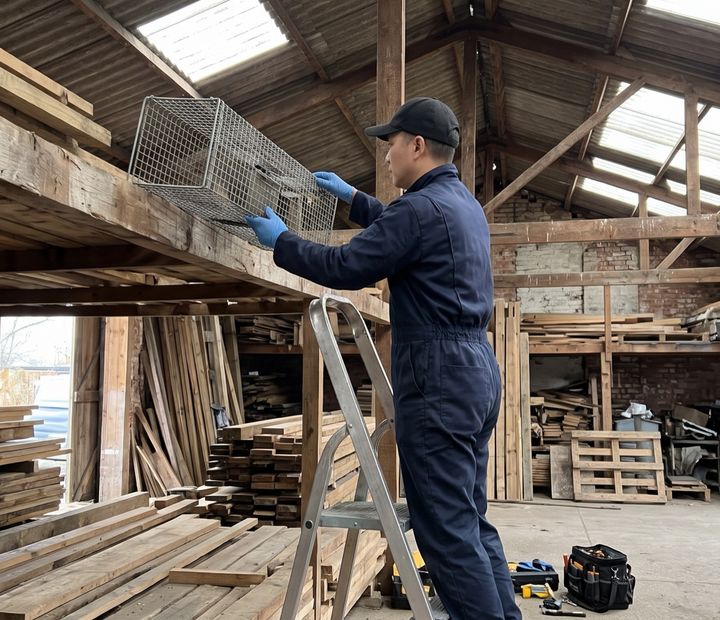
Northwest Environmental clears grey squirrels out of lofts, roof spaces and outbuildings in Lymm, including Oughtrington, Heatley and Booths Hill. We survey the roof, trap with daily checks, humanely dispatch greys as the law demands and seal the entry points. Warrington Borough Council does not treat squirrels, so ring us or fill in the website form.
Why do grey squirrels reach Lymm roofs so easily?
Grey squirrels thrive wherever trees, hedges and gardens meet, and Lymm is a village set inside the Green Belt with open countryside on every side. Its neighbourhood plan, published in June 2026, includes policies protecting trees, hedgerows and wildlife corridors, and the old Warrington and Altrincham railway line, closed to all traffic in 1985, now carries the Trans Pennine Trail across the parish as a long green strip. To a squirrel those features join up: hedgerow to tree line, tree line to garden, garden fence to a branch that hangs over the roof.
Two points in the year bring them indoors. In autumn they look for somewhere warmer and drier than a drey to spend the winter, and from late winter into spring females want a safe place for a litter. A loft with an easy way in meets both needs, so scratching overhead tends to begin in autumn or late winter and carries on until someone deals with it.
What do Lymm roofs tend to hide?
The houses built for business owners on the village edges in the mid-Victorian period were designed in Gothic and Italianate styles. Gothic houses tend to have steep gables trimmed with decorative bargeboards, and Italianate ones wide, overhanging eaves, often boxed in with soffits. Both create sheltered gaps behind timber, and a squirrel that gnaws through a softened board can be living in a large, rarely visited loft for months before anyone notices. The homes Manchester merchants built near the station after the railway arrived in 1853 share much of the same pattern.
The fustian workers’ cottages in the village have smaller roof spaces, so squirrels are usually heard sooner, around dawn and again in the late afternoon. Where cottages are joined, the loft void may not be fully divided from next door’s, and a survey has to take in the neighbouring roof as well. Further out, the listed farmhouses and their outbuildings bring stored feed, hay and old timber roofs into the picture.
What happens during a squirrel job in Lymm?
It begins with a survey from the ground and inside the loft. We look for each gap and every way up, work out how many squirrels are living in the roof and where the nest sits, and check for bats and nesting birds; because the law protects both, finding either can change the timetable. Then we explain the plan: where traps go, how the daily checks will work and what the law requires once a grey is caught.
Traps are placed along the routes the squirrels use inside the roof and checked at least once a day, with access agreed in advance. Greys are on the official list of invasive non-native species, so letting one go anywhere, however rural, is an offence without a licence, and the technician humanely kills any grey that is caught. Once the checks turn up nothing new, every gap is sealed, fouled insulation and nest debris are bagged up, and we point out any chewed cables for an electrician to test. A final visit confirms the roof is holding, and you receive a written summary.
Proofing older and listed roofs
Lymm has 55 listed buildings, including the sandstone-and-brick Lymm Hall, several farmhouses and a few timber-framed buildings, and the unlisted Victorian villas on the village edges are well over a century old. On these roofs, proofing is as much about what it looks like as what it stops. We replace chewed timber to match the original profile, tuck galvanised mesh behind existing features where it will not be seen, and avoid fixings that damage soft brick or stone. If a change on a listed property goes further than a like-for-like repair, it may need listed building consent, and we raise that before quoting the work.
Keeping squirrels away once they are out
Proofing does most of the job, but squirrels will test a roof again. Cut back branches within jumping distance of the eaves. Before pruning, find out from Warrington Borough Council whether the tree carries a preservation order, and leave any branch holding an active bird’s nest until the young have flown. Swap open bird tables for squirrel-resistant feeders, especially in gardens that back onto the farmland or the Trans Pennine Trail, where squirrels travel freely. Each autumn, walk round the house and look at bargeboards, soffits and the corners of the roof for fresh gnawing, and have soft or split timber repaired before winter. If the scratching starts again, an early call for squirrel removal saves a much bigger repair later, and if the noise happens mainly at night, ask about rat and mouse control instead, since squirrels keep daylight hours.
Squirrel Removal in Lymm: what we see locally
- Lymm is ringed by Green Belt farmland, and the hedgerows, trees and wildlife corridors its neighbourhood plan protects give grey squirrels connected routes from open country to garden trees and rooftops.
- The old railway line across the parish, closed in 1985 and now a stretch of the Trans Pennine Trail, runs as a continuous green strip, so houses close to it are within easy reach of squirrels moving along it.
- Mid-Victorian Gothic and Italianate houses on the village edges, and the merchants' homes built near the station after 1853, often have large, little-used lofts and decorative eaves where a gnawed gap can go unnoticed for months.
- With 55 listed buildings in the parish, including farmhouses and a few timber-framed buildings, proofing often has to be matched to historic materials, and some changes need listed building consent.
How we deal with it
- 1
Roof and loft survey
We trace every hole and climbing route from outside, then check the loft for the nest, how many squirrels are using it, damage to timber and cables, and any sign of bats or nesting birds.
- 2
A plan explained plainly
We set out where traps will go, how the daily checks will be covered, what the law requires for any grey squirrel caught, and anything you need to do first, such as clearing access to the loft hatch.
- 3
Trapping, checked every day
Cage traps, or spring traps approved for grey squirrels and set as their approval requires, go on the runs in the roof space and are checked at least once a day. Greys are humanely dispatched; a red squirrel would be released unharmed.
- 4
Proofing the way in
Once the loft is clear, entry points are closed with galvanised mesh, metal sheet or new timber, and chewed fascias, soffits and vents are repaired so another squirrel cannot reopen them.
- 5
Clean-up and checks
Nest material and soiled insulation are bagged and removed, and any gnawed cables are pointed out so an electrician can test them before the loft is used again.
- 6
Follow-up and report
We return to confirm there is no fresh activity and the proofing is holding, then send a written summary of what was found, caught and repaired.
Squirrel Removal in Lymm: frequently asked questions
Does the council deal with squirrels in Lymm homes?
Many councils run a pest control service for residents, but what is covered, who can book and the charges all vary and can change, so check the council's own pest control pages before you book. If you rent, report the problem to your landlord first. If you would rather book a private firm, call or message us to arrange a visit.
Our house is listed. Can you squirrel-proof the roof without spoiling it?
Yes, and we plan that part with you before trapping starts. Where a hole has been chewed through an old fascia or bargeboard, we replace the timber to match its profile and finish rather than covering it in sheet metal, and mesh is fitted out of sight behind existing features wherever possible. Alterations that affect a listed building's character can need listed building consent, so for anything beyond a like-for-like repair, speak to the council's conservation or planning officers first. We also look for bats, which often roost in older roofs and are protected.
Squirrels are getting into our barn and feed store near Heatley. Is that a different job?
The approach is the same, but the building changes the detail. Open-sided barns cannot be sealed like a loft, so we concentrate on the enclosed stores, lofts and tack rooms where squirrels nest or feed, and on storing grain, bird seed and livestock feed in lidded metal containers. Traps are placed where livestock, dogs and farm cats cannot reach them and checked every day. Once the building is clear, we proof the gaps that matter and show you what to watch for.
How often will you need to come to our house while traps are set?
At least once a day, every day, until the traps come out, which in a typical loft is between one and two weeks. Our base in Warrington is about six miles away, so daily checks fit easily into technicians' routes. Ahead of setting any trap, we settle how we will reach the loft hatch, whether a key holder is needed if you are away, and who to call at weekends. If the job runs on, we tell you why.
Can a squirrel be caught and released somewhere else?
Not if it is a grey squirrel. Greys are a listed invasive non-native species, and under the Invasive Alien Species (Enforcement and Permitting) Order 2019, as well as the Wildlife and Countryside Act 1981, it is an offence to release one or let it escape into the wild without a licence. That includes driving it to a wood a few miles away. A grey caught in a trap has to be humanely dispatched. Red squirrels are the opposite: they are protected, and one caught by mistake must be let go unharmed. Across most of our area a red in a loft is very unlikely; the Sefton coast and the countryside around it are the exception.
How can I tell whether it is squirrels or rats in my loft?
Timing is the best clue. Grey squirrels are active by day, so noise that starts around dawn and picks up again in the late afternoon points to squirrels, while scratching that begins after dark is more likely to be rats or mice. Squirrels usually get in high up, through a gnawed hole in the fascia or soffit near a tree or climbing plant, whereas rats tend to come up through wall cavities, drains or gaps low down. A bulky nest of leaves and shredded insulation is typical of squirrels. If you are unsure, a survey settles it before any traps go down.
Can I just block up the hole the squirrels are using?
Not while they are still inside. A squirrel shut into a loft will chew a new way out, sometimes through a ceiling into the house, and an animal left to starve suffers needlessly, which can be an offence under animal welfare law. From late winter to late summer there may also be young in the nest that cannot leave yet. Holes should be sealed only once the loft is clear, confirmed by checking for fresh activity, or in suitable cases after a one-way door has let the squirrels out. That is why proofing comes at the end of the job, not the start.
More in Lymm
Last updated: