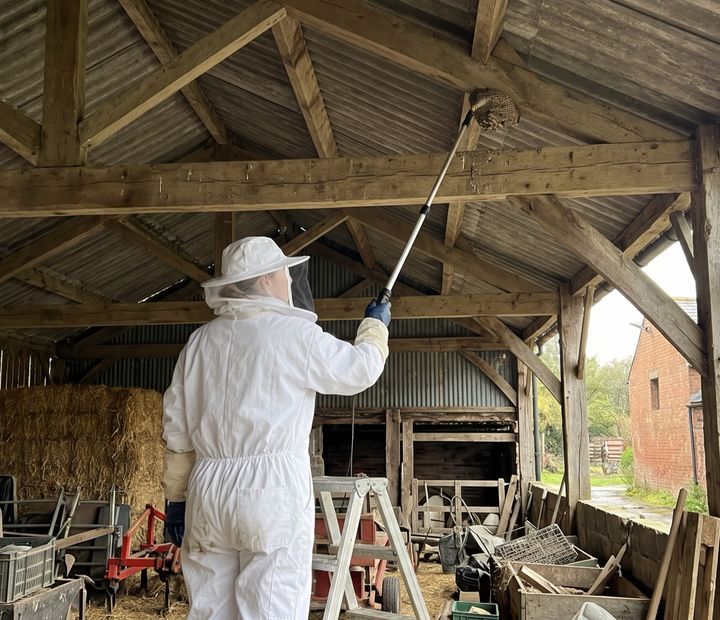
For Macclesfield homes and businesses, Northwest Environmental tackles wasp and hornet nests in silk-era terraces, converted mills and the Tytherington estate. Our technician traces the nest, places insecticide in its entrance, usually from the ground and in a single visit, and explains the aftercare. To arrange a visit, phone the office or complete the online enquiry form.
What draws wasp queens into Macclesfield’s silk-era roofs?
Each spring a mated queen leaves hibernation and searches for a cavity that is dry, still and near weathered wood she can chew into nest paper. The old centre of Macclesfield offers that on street after street. The 1830s terraces built for silk weavers carry a garret across the top floor, typically lit by a long run of windows, and many older houses hide a timber frame behind later brick. A gap where a garret window meets its surround, a slipped slate, an open joint at the wall head or an old vent is all a queen needs, and the roof space above a garret is warm, quiet and rarely visited.
By August a colony started in one of those voids can number several thousand wasps. Because terraced houses share a continuous roof line, the entrance a colony uses is sometimes on the neighbour’s side, or the wasps turn up indoors in one house while the nest sits above the next. We look along the whole run of roof before deciding where the treatment goes, and if the entrance is on a neighbouring property we ask for their agreement first.
Mill apartments, offices and the Tytherington estate
Converted mills add height to the problem. Hovis Mill, on the canal’s west bank, is now apartments; St George’s Street Mill holds offices; and Grade II* buildings such as Victoria Mills and Albion Mill rise several storeys above the street. A nest in the brickwork or under the eaves of a building like that can be beyond a lance used from the ground, so access is arranged with the managing agent or building manager, sometimes from an upper window or roof hatch instead of a ladder. Residents and staff are asked in advance to keep nearby windows shut while the work is done.
Tytherington is a different picture. Built after the hall was demolished in the 1960s, its houses tend to collect nests behind soffit and fascia boards, inside garages and in garden sheds, and most of these can be reached from the ground in a short visit. Tytherington Business Park, to the north-east, has landscaped borders and building edges that suit queens as well, so office managers there should look along eaves and entrances in early summer, before a colony grows large enough to bother staff.
Planning a nest treatment in Macclesfield
The council’s home service deals with rats and mice only, so a wasp nest at a house has to be handled privately. When you ring, tell us roughly where the wasps are flying, whether the house is listed or part of a converted building, and whether the garden runs down to the canal, the Bollin or a pond. That lets us plan access before we arrive. Many central terraces have no side passage, so reaching a rear eave can mean walking through the house or crossing a neighbour’s garden with their permission.
On the day, the technician checks first that the insects are not bees, tracks the wasps’ route home to the entrance and places a professional-use insecticide inside it. Close to water, the choice between foam and dust, and the exact point of application, are made so that nothing can reach the bank. The entrance is left open afterwards and the ground beneath it is best kept clear for the rest of the day. Shops, offices and food businesses can have the visit fitted in before opening or after closing, with a short written record of the nest and product used.
Hornets and the wooded eastern fringe
European hornets have spread northwards through England and do appear in Cheshire, though far less often than common wasps. They tend to choose hollow trunks, neglected outbuildings and cavities in walls near woodland, so the eastern edge of town, the wooded stretches of the Middlewood Way and the country out towards Macclesfield Forest are the likeliest places to meet one. We deal with a hornet nest along the same lines as a wasp nest, planning the visit around their habit of foraging into dusk. Until then, leave the colony alone and keep children and dogs well back.
Getting a Macclesfield property ready for next spring
Once the colony has died off in late autumn, closing the gap it used is the best way to stop a new queen choosing the same spot. On a listed house, use repairs that match the original, such as lime mortar in old brick joints, and check with Cheshire East Council’s conservation team before changing anything visible. Mesh fitted over vents should still let air through. Check garrets, lofts and sheds during spring, while a new nest is still smaller than a fist and quick to treat.
Bins play a part too. Cheshire East’s collection changes, due in early 2027, will see general waste picked up three-weekly and food waste weekly. Using the food caddy, rinsing drinks cans and bottles before they go into recycling and keeping lids shut will give late-summer foragers less reason to hang around a bin store, which matters most at mill conversions where many households share one.
Wasp & Hornet Nest Removal in Macclesfield: what we see locally
- Cheshire East Council's home service stops at rats and mice, so a domestic wasp nest in Macclesfield is either a private treatment or a do-it-yourself job.
- The 1830s silk-weavers' terraces, with a garret running across the top floor, give queens quiet roof voids, and a shared roof line can put a colony's entrance on the neighbour's side of the terrace.
- Nests high on multi-storey converted mills such as Hovis Mill can be out of reach from the ground, so access is agreed with the managing agent before the visit.
- Gardens beside the Macclesfield Canal and the River Bollin need the insecticide kept well away from the water, because most wasp products are toxic to fish.
- Tytherington's post-1960s houses mostly see nests behind soffits and fascias or in garages and sheds, which can usually be reached from ground level.
How we deal with it
- 1
Identify the insect and find the nest
We confirm it is wasps or hornets rather than bees, then follow the flight line back to the entrance, whether that is a gap under a tile, a soffit vent, an airbrick or a hole in the lawn.
- 2
Check the surroundings
Before treating we check for children, neighbours, pets, fish ponds, horses or livestock, staff and customers nearby, and ask whether anyone has a known sting allergy.
- 3
Treat the entrance
A professional-use insecticide dust or foam goes directly into the entrance, from the ground with an extension lance where possible. Returning wasps carry it inside, so hidden nests are reached too.
- 4
Leave the entrance open
We explain why the hole must not be blocked, how long to keep people and pets clear, and that a short burst of extra activity is normal while foragers return.
- 5
Remove the nest where it matters
Dead nests are usually left, because wasps never reuse them. Where a nest is in a living space, a well-used shed or a loft where it could draw other insects, we can take it out once inactive.
- 6
Confirm it has worked
Activity normally stops within 24 hours. If wasps are still using the same entrance after a couple of days, or a second nest appears, tell us and we will reassess.
Wasp & Hornet Nest Removal in Macclesfield: frequently asked questions
Our Macclesfield house is listed. Do we need permission before a wasp nest is treated?
Not for the treatment itself. Placing insecticide in the gap the wasps already use is not an alteration to the building, so listed building consent does not normally come into it. The question arises afterwards, if you want to change something visible to stop a queen returning, such as replacing a vent, fitting mesh or altering a garret window surround. For that kind of repair, speak to Cheshire East Council's conservation team first and use materials that match the original.
Wasps are getting into our flat in a converted mill. Who should arrange the treatment?
Usually the managing agent or management company, because the nest is almost always in the shared structure: under the eaves, behind a window surround or in a gap in the outer brickwork. Report it to them with a note of which window or room the wasps appear in. If they ask us to attend, we agree access to any roof hatch or upper window, ask other residents to keep their windows shut and leave the agent a note of where the nest was. Meanwhile, keep the affected window and room door closed.
There is a nest in a wall on the Macclesfield Canal towpath. Who deals with it?
The Canal & River Trust looks after the canal, so report a nest in the towpath, a bridge or a canal wall to the Trust as the body responsible for it. Walk past steadily rather than stopping to look, and keep dogs on a short lead. A nest in a garden wall, fence or shed on your side of the boundary is your responsibility, and we can treat it from within your property while keeping the insecticide away from the water.
We trade at the Treacle Market and wasps pester our stall in late summer. Can you help?
The nest will not be on your stall. Wasps around food and drink in late summer are foragers from colonies in nearby roofs, gardens or trees, so swatting and spraying at the pitch achieve very little. Keep sweet food covered, wipe up spills and use lidded bins for waste. If you notice a steady line of wasps heading to one point on a building, tell its owner or manager; with their agreement we can trace and treat the nest that is supplying them.
Will my council remove a wasp nest for free?
Probably not. Councils across Cheshire, Merseyside, Lancashire and Greater Manchester handle wasps differently: many charge for the work, some do not treat wasps in homes at all (Cheshire East, for example, treats only rats and mice), and free wasp treatment is uncommon. Where a council does offer it, appointments may be harder to get in late summer, when demand peaks, and there may be limits on the nests it will treat. Your council's pest control page will say what is available. If it does not cover your nest, or you need it dealt with sooner, we can treat it privately.
What kills a wasp nest instantly?
Nothing reliably does. Sprays that promise instant results knock down the wasps you can see, not the colony inside, and spraying a visible nest at close range mainly provokes it. Professional treatment works by placing insecticide dust or foam in the nest entrance; foragers carry it in and spread it through the nest. Expect a burst of activity for an hour or two, then a steady decline. Most nests are dead within 24 hours, although a large nest in a roof space can take a little longer.
Is it a wasp, a hornet or a bee, and will you treat bees?
Wasps are smooth, bright yellow and black, with a narrow waist. European hornets are larger, chestnut-brown and yellow, and often turn up at lit windows after dark. Bees are rounder and hairier. We do not treat honeybees, because insecticide in a honeybee nest can be carried away by bees from other colonies; a local beekeeper may be able to collect a swarm. Bumblebee nests die off naturally by late summer and are usually best left alone. If you are unsure, send us a clear photo before booking.
More in Macclesfield
Last updated: