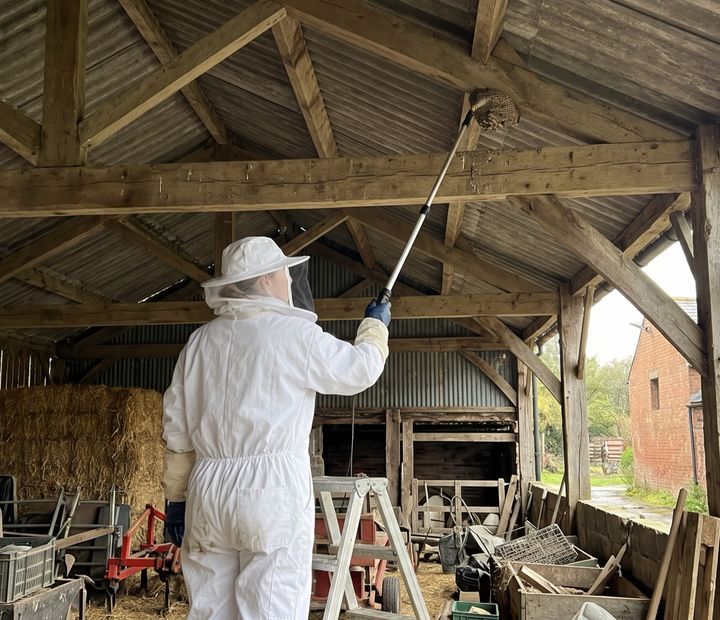
Northwest Environmental treats wasp and hornet nests at homes and workplaces in Wilmslow, Knutsford and Alderley Edge, including Handforth and Styal. A technician follows the flight line and puts professional insecticide into the entrance; most nests need one visit. Cheshire East's home service covers only rats and mice, so call us or use the website form to book.
Why do wasps find so many nest sites in these towns?
A queen leaving hibernation in spring wants a dry cavity with a small, sheltered way in, and the building stock here gives her a long list to choose from. The villas that went up for Manchester merchants after the railway arrived, and the houses Alderley Edge’s cotton barons built by 1850, often carry mock Tudor gables, carved bargeboards and several roof slopes meeting in valleys and hips. Each junction is a chance for a gap, and the lofts behind them are big and seldom visited, so a nest can grow all summer before anyone looks.
The timber-framed farmhouses are a different case. Roofs of heavy Kerridge stone slate, found on many of the area’s listed farmhouses including several in Styal, settle and lift slightly over the years, and old timber frames open up shakes and splits. On the overspill estates at Colshaw Farm, Spath Lane and Knutsford’s Longridge, built in the 1960s and 1970s, the nests we find are more often behind fascias and soffits, in airbricks and in garden sheds. The newest roofs, at Alderley Park, bring vented soffits and dry-fixed ridges, which a queen will test in April.
Where do wasps cause the most trouble in late summer?
By August a colony is raising new queens and males, and workers with fewer grubs to feed go looking for sugar. That is when they find outdoor tables. Knutsford’s two central streets carry a long run of restaurants, pubs and coffee shops, Alderley Edge village has its cafés, and Wilmslow’s centre around Bank Square, Grove Street and Water Lane has its own share. Tatton Park, north of Knutsford, stages more than a hundred events a year, the RHS flower show for the North West among them, and all of that puts food and drink outdoors at the peak of the season.
Workplaces see nests in cladding gaps, signage, canopies and bin stores. The retail park at Handforth Dean, the head offices on Altrincham Road, the Radbroke Hall campus on Toft Road and the laboratory buildings at Alderley Park all have the kind of large, busy frontages where a nest above a door or a smoking shelter quickly becomes a staff and visitor problem.
How does a treatment run here?
It starts with identification. Bees are left alone, and if a honeybee swarm has arrived, a local beekeeper is the right call. For wasps or hornets, the technician follows the flight line to the entrance and checks what is nearby: children, pets, neighbours in their gardens, a pond, or staff and customers on a business site.
Treatment goes into the entrance, not into the air. A professional-use insecticide dust or foam is applied with an extension lance from the ground wherever the nest allows, and returning wasps carry it inside. The entrance is left open, activity drops away within a day, and the dead nest is usually left in place. On listed buildings nothing is drilled or removed to reach a nest, and any making good afterwards should use matching materials, with consent where it is needed. Beside the Bollin, Booths Mere or Tatton’s meres, product stays in the entrance and nearby ponds are covered.
Cheshire East’s household service is limited to rats and mice, and its business contracts do not cover wasps, so homes and premises here arrange nest treatment privately. For shops, cafés and offices we time the visit before opening or after closing and leave a short written record of what was treated and where.
How can you make a nest less likely next spring?
Late October is a good moment to plan, because this year’s colonies are dying off and only mated queens survive the winter. Once a nest is dead, have lifted stone slates re-bedded, fit mesh over soffit vents and airbricks without blocking the airflow, and repoint open joints. Between late April and early June, look in lofts, garages, sheds and summerhouses, when a new nest is still the size of a golf ball. Cafés and pubs can cut late-summer traffic with lidded bins, quickly cleared tables and covered drinks. At home, the move to three-weekly black-bin collections and weekly food waste from early 2027 is a reason to use the food caddy for every scrap, which keeps sweet waste away from the bin store in August.
Wasp & Hornet Nest Removal in Wilmslow, Knutsford & Alderley Edge: what we see locally
- Railway-era villas in Wilmslow and Alderley Edge, built in mock Tudor, Italianate and Arts and Crafts styles, have busy rooflines with many gables, eaves and valleys where a queen can start a nest out of sight.
- Kerridge stone-slate roofs on the area's timber-framed farmhouses, several of them listed and some in Styal, can develop gaps under lifted slates that wasps return to in later summers.
- Tatton Park's programme of more than a hundred events a year, and the restaurants and coffee shops on Knutsford's Princess Street and King Street, put plenty of sweet food outdoors just as colonies peak.
- Gardens near the River Bollin, Booths Mere and Tatton's protected meres call for extra care, because many wasp insecticides are harmful to fish and other aquatic life.
- Cheshire East Council treats only rats and mice for households and does not include wasps in its business contracts, so nests here are dealt with privately or by the owner.
How we deal with it
- 1
Identify the insect and find the nest
We confirm it is wasps or hornets rather than bees, then follow the flight line back to the entrance, whether that is a gap under a tile, a soffit vent, an airbrick or a hole in the lawn.
- 2
Check the surroundings
Before treating we check for children, neighbours, pets, fish ponds, horses or livestock, staff and customers nearby, and ask whether anyone has a known sting allergy.
- 3
Treat the entrance
A professional-use insecticide dust or foam goes directly into the entrance, from the ground with an extension lance where possible. Returning wasps carry it inside, so hidden nests are reached too.
- 4
Leave the entrance open
We explain why the hole must not be blocked, how long to keep people and pets clear, and that a short burst of extra activity is normal while foragers return.
- 5
Remove the nest where it matters
Dead nests are usually left, because wasps never reuse them. Where a nest is in a living space, a well-used shed or a loft where it could draw other insects, we can take it out once inactive.
- 6
Confirm it has worked
Activity normally stops within 24 hours. If wasps are still using the same entrance after a couple of days, or a second nest appears, tell us and we will reassess.
Wasp & Hornet Nest Removal in Wilmslow, Knutsford & Alderley Edge: frequently asked questions
Wasps are going in under the stone slates of our listed farmhouse near Styal. Can you treat it without damaging the roof?
Usually, yes. We treat through the gap the wasps are already using, with an extension lance from the ground or a safe working position, so no slates need to be lifted to reach the nest; returning wasps carry the insecticide inside. Once the colony is dead, the gap can be re-bedded by a roofer who knows Kerridge stone slate. Because the house is listed, check with Cheshire East's conservation officers before anything goes beyond a like-for-like repair.
We have a new house at Alderley Park and wasps are using a soffit vent. Is that normal?
It is common on newer roofs. Vented soffits, dry-fixed ridges and verge units leave small openings that a queen will investigate in spring, and a vent with a missing or loose insect grille is an easy way in. We treat the nest through the vent, then advise on fitting a grille or mesh that keeps the airflow the roof needs. If the house is still within the builder's defects period, report any missing grille to the developer.
Wasps are pestering our outdoor tables in Alderley Edge village, but there is no nest on our premises. What can you do?
Foraging wasps travel some distance, so the nest may be in a neighbour's roof, a hedge or a tree well away from your tables. We check your building, yard and bin store first and treat any nest on property you control. Beyond that, the fixes are practical: lidded bins emptied often, tables cleared and wiped quickly, drinks covered where possible and sweet waste kept away from seating. If the flight line points to a nest elsewhere, we will tell you, so the owner can arrange treatment.
The nest is high on a gable of our Wilmslow villa. Will you need scaffolding?
Rarely. Our extension lances reach most eaves and gable apexes from the ground, which keeps us off ladders beside an active colony. Where the entrance is higher, or hidden behind a decorative bargeboard, we may treat from an upstairs or attic window, or from inside the loft if the nest is in the roof space. A tower or scaffold is only worth arranging if there is no other safe way to reach it, and we would talk that through with you before booking anything.
Will my council remove a wasp nest for free?
Probably not. Councils across Cheshire, Merseyside, Lancashire and Greater Manchester handle wasps differently: many charge for the work, some do not treat wasps in homes at all (Cheshire East, for example, treats only rats and mice), and free wasp treatment is uncommon. Where a council does offer it, appointments may be harder to get in late summer, when demand peaks, and there may be limits on the nests it will treat. Your council's pest control page will say what is available. If it does not cover your nest, or you need it dealt with sooner, we can treat it privately.
What kills a wasp nest instantly?
Nothing reliably does. Sprays that promise instant results knock down the wasps you can see, not the colony inside, and spraying a visible nest at close range mainly provokes it. Professional treatment works by placing insecticide dust or foam in the nest entrance; foragers carry it in and spread it through the nest. Expect a burst of activity for an hour or two, then a steady decline. Most nests are dead within 24 hours, although a large nest in a roof space can take a little longer.
Is it a wasp, a hornet or a bee, and will you treat bees?
Wasps are smooth, bright yellow and black, with a narrow waist. European hornets are larger, chestnut-brown and yellow, and often turn up at lit windows after dark. Bees are rounder and hairier. We do not treat honeybees, because insecticide in a honeybee nest can be carried away by bees from other colonies; a local beekeeper may be able to collect a swarm. Bumblebee nests die off naturally by late summer and are usually best left alone. If you are unsure, send us a clear photo before booking.
More in Wilmslow, Knutsford & Alderley Edge
Last updated: