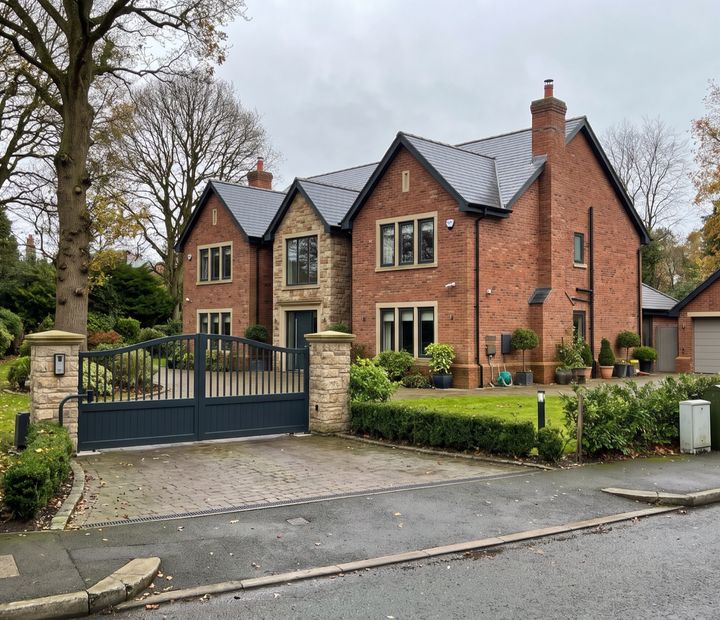
Northwest Environmental handles pest problems for homes and businesses in Wilmslow, Knutsford and Alderley Edge, including Handforth, Styal and Dean Row. We treat wasp nests, clear grey squirrels from lofts, control rats and mice, and run monitoring contracts for shops, offices and kitchens. Phone us or fill in the website form and we will schedule a visit from Warrington.
What kinds of buildings shape pest work here?
Most of the housing exists because of the railway. When the line reached Wilmslow in 1842, the place amounted to a church and a handful of farms; wealthy merchants then moved out and built along the new commuter route. Alderley Edge filled up even faster, with around thirty substantial houses for Manchester cotton barons standing by 1850, dressed in mock Tudor, Italianate and Arts and Crafts styles. For us, those villas mean roomy lofts that rarely get visited, decorative timber bargeboards and roofs where several slopes meet. Every one of those junctions is a possible way in for a wasp queen in April or a grey squirrel in October.
Some buildings are far older. The Wilmslow area has 81 listed buildings, among them timber-framed farmhouses roofed in heavy Kerridge stone slate, including Grade I Beech Farmhouse and several in Styal. Lifted slates and shrunken timbers leave gaps, and closing them has to respect the historic fabric.
Then comes the post-war layer. Colshaw Farm in Wilmslow and Spath Lane in Handforth were built as overspill estates for families leaving inner-city Manchester in the 1960s and 1970s, and Manchester City Council put up the Longridge estate in Knutsford’s Over Ward during the 1960s. On estates of that age, our rodent work tends to centre on bin stores, drains and garden boundaries rather than lofts. Newest of all are the homes at Alderley Park, where a 2016 masterplan allowed up to 275 houses and the first phases started in 2017. On new roofs we check vented soffits and dry-fixed ridges, which can leave small openings in the first few seasons.
Why does living near the Bollin raise the odds of rats?
The River Bollin ties much of the area together. It flows through The Carrs Park in Wilmslow, under the pair of brick railway viaducts near the station, takes in the River Dean close to Styal, passes Quarry Bank Mill and then vanishes into a culvert beneath the southern runway at Manchester Airport. Brown rats favour soft banks to dig into with water close at hand, so properties near the river and its side streams tend to see more of them. They rarely stay on the bank. Runs lead into hedges, under decking and sheds, and in the colder months into wall cavities and kitchens.
Knutsford’s water is mostly still rather than flowing. Tatton Park’s two meres are protected as Sites of Special Scientific Interest and Ramsar wetlands, Booths Mere lies to the east of the town, and the River Lily and Birkin Brook feature in the town’s history. Near any open water we keep insecticides confined to the treatment point, because many of them harm fish and other aquatic life.
How do the moss, the Edge and the big estates affect homes on the fringe?
Wilmslow sits beside Lindow Moss, a raised peat bog that has shrunk to roughly a tenth of its former 600-plus hectares. Peat cutting has stopped, restoration began in 2022, and it adjoins the Lindow Common SSSI. Above Alderley Edge, the National Trust’s red sandstone escarpment draws around 300,000 visitors a year. North of Knutsford, Tatton Park’s 2,000-acre estate has a deer park, a Home Farm with livestock and more than a hundred events a year, the RHS flower show for the North West among them.
Houses that back onto open ground like this get two seasonal visitors. In autumn, wood mice and squirrels move from the fringe into garages, sheds and lofts. In late summer, picnic and event food draws foraging wasps, and gardens nearest the green spaces see the heaviest traffic.
What do head offices, labs and shops need from pest control?
Several national organisations run their head offices here. Royal London has a major base in Wilmslow, Umbro was founded and is still headquartered in the area, and Waters Corporation runs its UK headquarters from Altrincham Road. Alderley Park, the former ICI and AstraZeneca pharmaceutical site bought by Manchester Science Parks and Bruntwood in 2014, had more than 150 companies in its offices and laboratories by 2017. Outside Knutsford, the Barclays campus at Radbroke Hall on Toft Road employs about 3,000 people in IT and support roles, and the retail park at Handforth Dean, beside the A34 bypass, adds supermarkets and large chain stores.
Food and drink cluster in three places: Bank Square, Grove Street and Water Lane in Wilmslow; Princess Street and King Street, Knutsford’s Top and Bottom streets, where a bar now fills Alfred Waterhouse’s former town hall; and the cafés and designer shops of Alderley Edge village, with the historic De Trafford Arms. Our commercial pest control for sites like these means monitoring visits timed around trading or office hours, bait stations placed where staff and visitors will not disturb them, and a record for each visit that an environmental health officer or auditor can follow. Buildings changing hands need watching too. The Information Commissioner’s Office planned to leave its Wilmslow offices for Manchester when its lease ended this autumn, and quiet, half-empty floors are where rodents settle unnoticed.
What does Cheshire East Council cover, and where does it stop?
For households, the council runs a charged service that deals only with rats and mice, on weekdays in office hours, and for any other pest it suggests a specialist firm or treating the problem yourself. Businesses cannot book a one-off visit at all. Instead the council offers a tailored contract with a site inspection, a written quotation and visit reports, covering ants, cluster flies, fleas, mice, rats and stored product pests. A wasp nest or squirrels in the loft are therefore for the householder to arrange, which is where our wasp nest removal and squirrel removal come in, alongside rat and mouse control for anyone who wants proofing done on the same visit.
Will three-weekly bin collections bring more rodents?
From early 2027, Cheshire East plans to empty black general-waste bins every three weeks and collect food waste weekly, and collection days may change when the food service starts. A survey of pest controllers published by the National Pest Technicians Association reported autumn rat activity up 38% nationally and mice up an average of 29%, rising most strongly in regions that include the North West. More than half of those asked blamed poor waste handling and overflowing bins. The practical answer is to put every scrap into the food caddy, keep lids shut, rinse containers and never leave bags beside a full bin.
How do we schedule visits across the area?
Our technicians come out from Warrington on planned rounds, so trap checks, monitoring visits and follow-ups land on agreed days. Wilmslow sits on the Crewe to Manchester spur of the West Coast Main Line and is the junction for the Styal Line through the airport, and Knutsford station, opened in 1862, is a stop on the Mid-Cheshire Line. Railway embankments make convenient corridors for rats and squirrels, so homes and premises beside the lines get a closer look on a survey. The same rounds continue to Macclesfield, seven miles south-east of Wilmslow, and west towards Lymm and Northwich.
What Cheshire East Council offers
Cheshire East Council runs a charged pest control service for households that deals with rats and mice only, with weekday appointments in office hours, and for any other pest it points residents to a specialist firm or to treating it themselves. Businesses cannot book a one-off treatment; instead the council offers a tailored contract with a site inspection, written quotation and visit reports, limited to ants, cluster flies, fleas, mice, rats and stored product pests.
Council pest control page (checked 2026-10-24).
Our services in Wilmslow, Knutsford & Alderley Edge
Wasp & Hornet Nest Removal in Wilmslow, Knutsford & Alderley Edge
Many-gabled railway-era villas and stone-slate farmhouses give spring queens plenty of sheltered gaps, and Tatton Park's busy events calendar and the café trade feed the workers in late summer. Wasps sit outside the council's home service.
Squirrel Removal in Wilmslow, Knutsford & Alderley Edge
Large, seldom-visited lofts in the older villas, with The Carrs, Lindow Common and Tatton's parkland close to many homes, give grey squirrels both a route and a destination. The council does not treat squirrels.
Rat & Mouse Control in Wilmslow, Knutsford & Alderley Edge
The Bollin and the Dean, Tatton's meres and Booths Mere give brown rats water and banks to burrow into, and three-weekly black-bin collections from early 2027 will make bin hygiene matter more.
Commercial Pest Control in Wilmslow, Knutsford & Alderley Edge
Head offices, Alderley Park's laboratories, the Radbroke Hall campus, Handforth Dean and the restaurants of Knutsford and Alderley Edge need scheduled monitoring and records, and Cheshire East will not make one-off business visits.
Domestic Pest Control in Wilmslow, Knutsford & Alderley Edge
Whether the home is a cotton baron's villa, a house on one of the overspill estates or a new build at Alderley Park, the council's household service stops at rats and mice and runs on weekdays only.
Other services available in Wilmslow, Knutsford & Alderley Edge:
Local factors behind pest problems in Wilmslow, Knutsford & Alderley Edge
- The River Bollin flows through The Carrs Park in Wilmslow and beneath two brick railway viaducts near the station, is joined by the River Dean close to Styal, runs past Quarry Bank Mill and then passes in a culvert under Manchester Airport's southern runway. [Wikipedia]
- Lindow Moss, a raised peat bog on the edge of Wilmslow, is now about a tenth of its original area of more than 600 hectares; peat cutting has stopped, restoration work began in February 2022 and the bog lies next to the Lindow Common SSSI. [Wikipedia]
- Tatton Park, north of Knutsford, is a National Trust estate of around 2,000 acres managed by Cheshire East Council under a lease, with a farm, a deer park and two meres that are protected as SSSIs and Ramsar sites. [Wikipedia]
- Manchester businessmen began building in Alderley Edge once the railway arrived in 1842, and by 1850 around thirty substantial houses had been put up, mostly for cotton barons, in styles such as mock Tudor, Italianate and Arts and Crafts. [Wikipedia]
- Spath Lane in Handforth and Colshaw Farm in Wilmslow were built in the 1960s and 1970s as overspill estates for people moving out of inner-city Manchester. [Wikipedia]
- Manchester City Council built the Longridge overspill estate in Knutsford's Over Ward during the 1960s. [Wikipedia]
- The Wilmslow area has 81 listed buildings, one at Grade I and eight at Grade II*, and many are timber-framed farmhouses with Kerridge stone-slate roofs, Beech Farmhouse and several in Styal among them. [Wikipedia]
- Alderley Park, the former ICI and AstraZeneca pharmaceutical site at Nether Alderley, was bought by Manchester Science Parks with Bruntwood in 2014, held more than 150 companies in offices and laboratories by 2017, and has a masterplan for up to 275 new homes. [Wikipedia]
- Handforth Dean is a retail park beside the A34 bypass with supermarkets and chain stores, and Pets at Home has its head office in Handforth. [Wikipedia]
- From early 2027 Cheshire East plans to collect black general-waste bins every three weeks and food waste every week, and collection days may change when the food-waste service begins. [Cheshire East Council]
Pest control in Wilmslow, Knutsford & Alderley Edge: frequently asked questions
What pest control does Cheshire East Council offer in Wilmslow and Knutsford?
For households, the council runs a charged service that treats rats and mice only, with appointments on weekdays in office hours, and it is open to domestic properties alone. For any other pest it suggests a specialist firm or treating the problem yourself. Businesses cannot book a single visit: the council offers a tailored contract, with an inspection, a written quotation and visit reports, covering ants, cluster flies, fleas, mice, rats and stored product pests. Wasps, squirrels and birds are on neither list. Check the council's pest control pages for the current details before you decide.
Do you cover Handforth, Styal, Dean Row and the Knutsford side?
Yes. Our work here runs across the SK9 district, which takes in Wilmslow, Handforth, Styal and Alderley Edge, and the WA16 district centred on Knutsford. That includes Dean Row to the east of Wilmslow town centre, the Colshaw Farm, Spath Lane and Longridge estates, Alderley Park at Nether Alderley and the farms and cottages on the rural edges in between. Give us the full address and postcode when you get in touch, and we will fit the visit into a planned route from Warrington.
Our garden runs down to the Bollin near The Carrs. Is that why we keep seeing rats?
It is a likely factor. A river gives brown rats water, food carried along the banks and soft ground to burrow into, and the Bollin runs straight through The Carrs on its way towards Styal. From the bank, rats move up into gardens for bird food, compost and the dry space beneath decking or sheds. We trace the runs, place tamper-resistant bait stations or traps on your side of the boundary and seal gaps around the house. Burrows on the riverbank or in the park itself are for the landowner to deal with.
Can you proof an old timber-framed farmhouse with a stone-slate roof without damaging it?
Yes, with care. Kerridge stone slates are heavy and often bedded on old timber, so we avoid anything that cracks or lifts them, and favour re-bedding by a suitable roofer, matched timber repairs and discreet mesh tucked behind existing features. Many farmhouses around Wilmslow and Styal are listed, and alterations that affect a listed building's character can need consent, so for anything beyond a like-for-like repair speak to Cheshire East's conservation officers first. We also look for bats before sealing an older roof, because they are protected.
Will three-weekly black-bin collections from 2027 bring more rats?
They could, if waste is handled badly. Cheshire East plans to empty black bins every three weeks from early 2027 and collect food waste weekly, and collection days may move when that starts. Rats and mice follow food, so the risk comes from scraps left in the black bin for three weeks or bags piled beside a full one. Use the food caddy for every scrap, keep lids shut, rinse containers and keep bins away from back doors. If burrows appear near a bin store, get them looked at early.
Our café is on King Street. The council will not do a one-off visit, so what are our options?
Cheshire East does not offer one-off treatments for business premises, only a tailored contract for a set list of pests. We can do either: a single visit for a wasp nest, a mouse problem or an insect issue, or a scheduled programme with monitoring points, visit reports and records an environmental health officer can follow. On a busy street of restaurants, pubs and coffee shops, we also look at shared walls, back yards and bin areas, because pests move freely between neighbouring units.
Can visits to offices and laboratories be scheduled around working hours?
Yes. On campus and head-office sites, such as the laboratories at Alderley Park or the offices along Altrincham Road, we agree visit windows with facilities staff, often early or late in the day, and place bait stations and monitors where staff and visitors will not disturb them. Laboratory and clean areas need product choices agreed in advance. Each visit is written up with findings, actions and station locations, so your file is ready for an auditor or inspector.
Nearby areas we also cover
Sources (10)
Last updated: